
FC Barcelona vs Real Madrid: Complete Tactical Analysis
Real Madrid vs FC Barcelona Tactical Analysis
Table of Contents
Opening: Echoes of Jeddah
You could feel it in the air, couldn’t you? Even through the screen, the desert air in Jeddah crackled not just with heat, but with the electric weight of history. As the final whistle pierced the night sky at the King Abdullah Sports City on January 11, 2026, it wasn’t just another trophy lift for FC Barcelona; it was a statement that left you breathless. We often reduce football to cold numbers—possession percentages, xG, pass completion maps—but Sunday’s El Clásico was a visceral reminder of why you watch this game.
It was the sight of a 17-year-old Lamine Yamal dancing past seasoned veterans as if they were training cones. It was the roar of a crowd divided by loyalty but united by awe. It was the tactical chess match between two of the game’s finest minds, Xabi Alonso and Hansi Flick, playing out right before your eyes.
For Xabi Alonso, this was a bitter pill to swallow—a 3-2 defeat where his side showed incredible heart but lacked the final checkmate. For Hansi Flick, it was the ultimate validation of a high-risk, high-reward philosophy that has defined his tenure. But beyond the raw emotion, the 3-2 scoreline hides a treasure trove of strategic nuances that you might have missed in the chaos. To truly understand how this masterpiece unfolded, you need to look beyond the highlights. You need to dive deep into the Real Madrid vs FC Barcelona Tactical Analysis, dissecting the moves that turned a football match into a modern classic.
Match Overview & The Narrative of 2026
If you have been following La Liga this season, you know the context was already boiling over. Entering January 2026, Barcelona sat just 4 points clear at the top of the table. Real Madrid, in their transition year under Xabi Alonso following the Ancelotti era, have been lethal but occasionally disjointed. The Spanish Super Cup Final wasn’t just about a piece of silverware; it was about psychological dominance for the rest of the season.
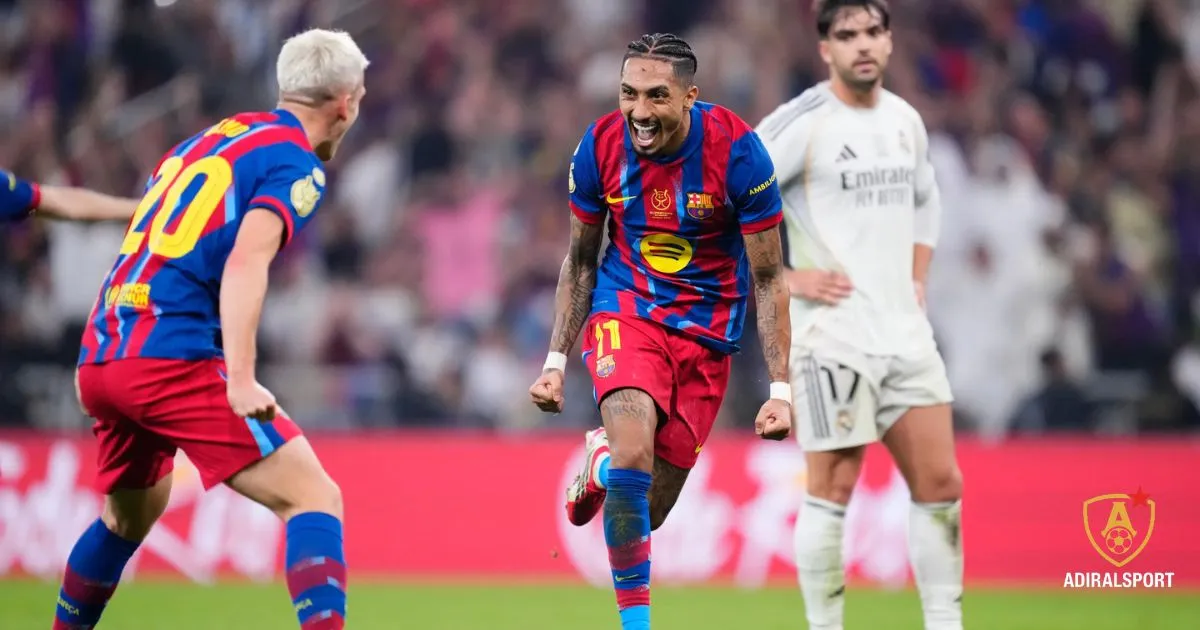
When you look at the Real Madrid vs FC Barcelona Tactical Analysis from a macro perspective, this game was a clash of ideologies. Alonso’s Madrid wants to kill you with precision in transition; Flick’s Barcelona wants to suffocate you in your own half. The result was a thriller ending FC Barcelona 3 – 2 Real Madrid, with goals from Raphinha (35′, 72′) and Lewandowski (48′) for Barca, and Vinícius Jr (46′) and the surprise package Gonzalo García (50′) for Madrid.
This wasn’t just a game; it was a warning shot. And as you peel back the layers of this Real Madrid vs FC Barcelona Tactical Analysis, you begin to see exactly where the battle was won and lost.
Confirmed Lineups & Formations
Before you can understand the movement, you have to understand the pieces on the board. Both managers were handcuffed by significant injuries, which forced their hands tactically. Barcelona was missing the grit of Gavi and the security of Ter Stegen, while Madrid had to bench their galactic superstar, Kylian Mbappé, due to a nagging knee strain.
Understanding these lineups is the starting point for any rigorous Real Madrid vs FC Barcelona Tactical Analysis.
Table 1: Starting XI – Supercopa Final 2026
| Position | FC Barcelona (4-3-3) | Real Madrid (4-3-1-2) |
| GK | Iñaki Peña | Thibaut Courtois |
| RB | Jules Koundé | Fede Valverde (Hybrid Role) |
| CB | Pau Cubarsí | Éder Militão |
| CB | Eric García | Raúl Asencio |
| LB | Alejandro Balde | Álvaro Carreras |
| CDM | Frenkie de Jong | Eduardo Camavinga |
| CM | Pedri | Aurélien Tchouaméni |
| CM | Fermín López | Jude Bellingham (CAM) |
| RW | Lamine Yamal | Rodrygo |
| ST | Robert Lewandowski | Vinícius Jr |
| LW | Raphinha | Gonzalo García |
When you look at Madrid’s setup, the inclusion of youngster Gonzalo García on the left wing (pushing Vini central) was Alonso’s curveball. In any standard Real Madrid vs FC Barcelona Tactical Analysis, you expect Vini wide, but Alonso wanted to overload the central channels against Eric García.
Tactical Deep Dive – Flick’s Press vs. Alonso’s Transition
This is where the game was truly decided. If you watched closely, you saw two heavyweights trading punches with completely different styles.
Flick’s High Line: The Gamble That Paid Off
Hansi Flick’s defensive line, marshaled by the teenage prodigy Pau Cubarsí, played with a bravery that bordered on insanity. They compressed the pitch, squeezing up to the halfway line even when Madrid had possession. A key element of this Real Madrid vs FC Barcelona Tactical Analysis is evaluating the risk of this high line against Vinícius’s speed.
You might think this is suicide against Vini Jr, but Flick knew that by compressing the space, Madrid’s midfielders would have no time to lift their heads and pick the pass. The data backs this up: Madrid was caught offside 6 times in the first half alone. You could see the frustration growing on Vinícius’s face as run after run was flagged.
Alonso’s Diamond Midfield
On the other side, Xabi Alonso utilized a diamond midfield with Jude Bellingham at the tip. His goal was to overload Barca’s lone pivot, Frenkie de Jong. When you study the Real Madrid vs FC Barcelona Tactical Analysis, you see that Bellingham constantly drifted into the “half-spaces” between Barca’s center-backs and full-backs.
However, the “Gonzalo García Surprise” was the real talking point. Alonso instructed the youngster to stay extremely wide on the left, stretching the pitch. This forced Jules Koundé to make a choice: stay compact with his center-backs or go out to mark García. This hesitation is what allowed Vinícius to find space for the equalizer. We cannot complete a Real Madrid vs FC Barcelona Tactical Analysis without crediting Alonso’s bold use of youth in such a high-pressure environment.
The Raphinha Factor – Deciding the Game
While the systems were complex, the difference-maker was individual brilliance. Raphinha was simply unplayable. In previous seasons, you might have seen him hug the touchline, but under Flick, he has evolved.
In this match, Raphinha frequently drifted inside from the left, acting almost as a second striker next to Lewandowski. This movement caused chaos for Madrid’s right side. Valverde, playing a hybrid right-back/midfield role, didn’t know whether to track him or pass him off to Militão.
The winning goal in the 72nd minute was the perfect example of this. You saw Raphinha pick up the ball in a central pocket, turn, and drive at the heart of the defense. His shot took a wicked deflection off Asencio, but it was his relentless movement that created the luck. Raphinha’s “Man of the Match” performance is central to our Real Madrid vs FC Barcelona Tactical Analysis, proving that tactical discipline must be paired with individual freedom.
Timeline of Key Moments
To understand the flow of the game, you have to look at how the momentum swung back and forth. It was a pendulum of emotion.
- 35′ – GOAL: Raphinha cuts inside and fires low past Courtois. (Barca 1-0)
- 46′ – GOAL: Immediately after the break, Vinícius Jr produces a moment of magic, spinning Cubarsí and finishing. (1-1)
- 48′ – GOAL: Chaos in the box. Lewandowski taps in a rebound. (Barca 2-1)
- 50′ – GOAL: The shocker. Gonzalo García ghosts in at the back post to volley home a Valverde cross. (2-2)
- 72′ – GOAL: Raphinha strikes again, the deflection silencing the Madrid end. (Barca 3-2)
- 90+1′ – RED CARD: Frenkie de Jong produces a “professional foul” on substitute Kylian Mbappé to stop a certain goal.
Tracking these momentum shifts is vital for an accurate Real Madrid vs FC Barcelona Tactical Analysis, as it shows how neither team could truly control the game for long periods.
Statistical Breakdown (The Numbers Game)
You can argue about opinions, but you can’t argue with data. The stats paint a picture of Barcelona dominance with the ball, but Real Madrid lethality on the break.
- Possession: Barcelona held 62% of the ball. This is classic Flick—control the chaos.
- xG (Expected Goals): Barcelona (2.1) vs. Real Madrid (1.8). The match was closer than the possession suggests.
Data provides the objective backbone to our Real Madrid vs FC Barcelona Tactical Analysis, confirming that while Barca controlled the flow, Madrid created high-quality chances.
Table 2: Match Statistics – Jan 11, 2026
| Statistic | FC Barcelona | Real Madrid |
| Goals | 3 | 2 |
| Possession | 62% | 38% |
| Shots (On Target) | 14 (7) | 11 (5) |
| Pass Accuracy | 89% | 82% |
| Fouls Committed | 12 | 15 |
| Yellow Cards | 3 | 4 |
| Red Cards | 1 (De Jong) | 0 |
The Mbappé Cameo & The Red Card
The final dramatic twist came in the 75th minute. You saw the board go up: Kylian Mbappé entering the fray. Despite recovering from a knee strain, his sheer presence terrified the Barcelona backline.
Suddenly, Barca’s high line dropped five meters. They were scared. And they were right to be. In stoppage time, Mbappé burst clear through on goal. It looked like the equalizer was inevitable. Then, you saw Frenkie de Jong make the ultimate sacrifice. He cynically tripped Mbappé just outside the box.
It was a straight red card, no arguments. But it saved the game. Analyze Frenkie de Jong’s decision to take a red card in stoppage time, and you realize it was a calculated tactical foul. This specific moment redefined the closing stages of this Real Madrid vs FC Barcelona Tactical Analysis, showcasing the dark arts required to win trophies.
Conclusion – What This Means for La Liga
So, what are you left with? Barcelona takes the Super Cup back to Catalonia, but Real Madrid proved they can hurt Flick’s system even without a fully fit squad.
The 4-point gap in La Liga remains, but the psychological edge has shifted. Barcelona knows they can beat Alonso’s Madrid in a shootout. Madrid knows they can breach Barca’s high line if they time their runs better.
As we wrap up this Real Madrid vs FC Barcelona Tactical Analysis, it is clear that the rivalry is entering a new golden age under Alonso and Flick. You are watching two master tacticians push each other to the limit. If this match was any indication, the second half of the 2025/2026 season is going to be unmissable.
FAQ Section
Q: Who won the Real Madrid vs FC Barcelona match in January 2026?
A: FC Barcelona won the match 3-2 to secure the Spanish Super Cup title in a thrilling contest in Jeddah.
Q: What was the main takeaway from the Real Madrid vs FC Barcelona Tactical Analysis of this match?
A: The main takeaway from the Real Madrid vs FC Barcelona Tactical Analysis was that Hansi Flick’s high-pressing system exposed gaps in Madrid’s defense, though Xabi Alonso’s counter-attacks remained dangerous throughout the ninety minutes.
Q: Did Kylian Mbappé play in the 2026 Super Cup Final?
A: Yes, he came off the bench in the 75th minute as he was recovering from a knee injury. His introduction was a key point in the Real Madrid vs FC Barcelona Tactical Analysis regarding player fitness management and late-game impact.
Q: Why was Frenkie de Jong sent off?
A: He received a straight red card for a tactical foul to stop a goal-scoring opportunity by Mbappé in stoppage time. This moment was pivotal in preserving Barcelona’s lead.
Q: Where can I find a deeper Real Madrid vs FC Barcelona Tactical Analysis?
A: You can find more detailed Real Madrid vs FC Barcelona Tactical Analysis breakdowns on major sports analytics sites, or by re-reading the deep dive section of this article which covers the pressing structures and transition play in detail.
Final Thoughts
The 2026 Supercopa de España was more than a final; it was a manifesto of modern football. Through this Real Madrid vs FC Barcelona Tactical Analysis, you have seen how the bravery of Barcelona’s high line overcame the lethal precision of Real Madrid’s transition play. Raphinha’s brilliance and De Jong’s sacrifice will be remembered, but the tactical battle between Flick and Alonso is just beginning. For fans and analysts alike, this Real Madrid vs FC Barcelona Tactical Analysis serves as a benchmark for the remainder of the 2025/2026 season. As the teams return to La Liga action, the lessons you learned here will undoubtedly shape the next chapter of this eternal rivalry.