
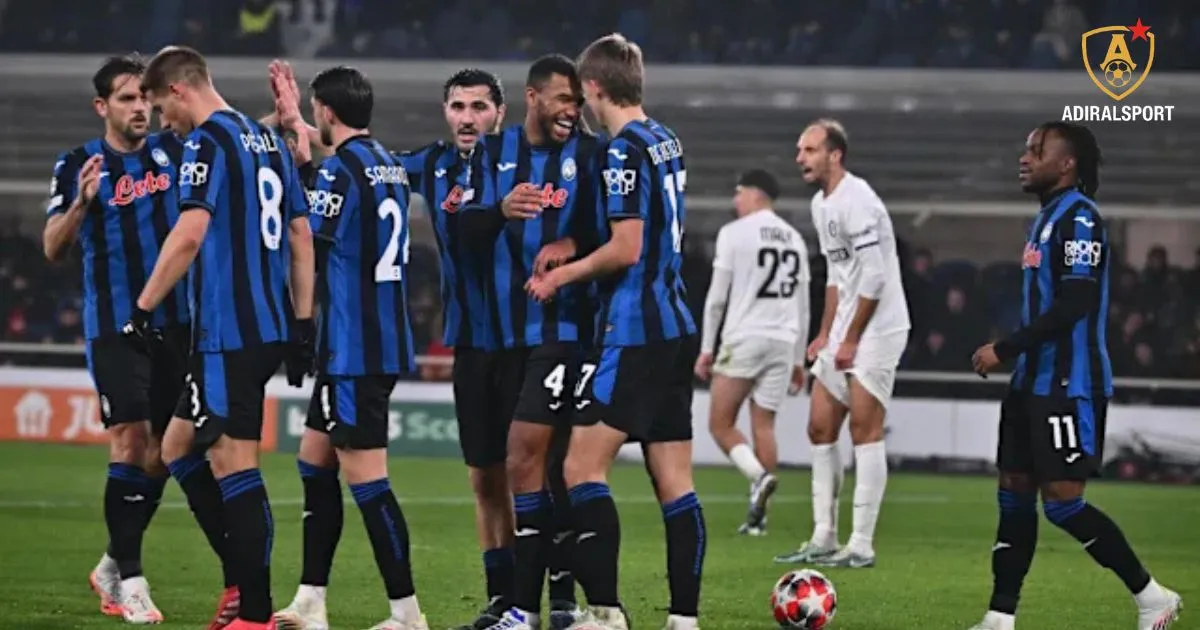
Marseille vs Atalanta Tactical Analysis
Table of Contents
Marseille vs Atalanta Tactical Analysis: Jurić’s 0-1 Defensive Masterclass Shatters De Zerbi’s Possession Game
It’s the 90th minute at the Vélodrome. If you were there, or even watching from home, you could feel the air change. The noise from 67,000 voices, so full of electric hope for an hour and a half, just… stopped. It was thick, heavy, and suddenly filled with a single, collective plea: “Don’t let it end like this.”
For 89 minutes, you’d watched Roberto De Zerbi’s Marseille do what they do. They probed. They pressed. They held the ball (53.1% possession, as the stats sheet coldly reminds us). You saw them whip in seven corners and fire off 15 different shots. On paper, on your screen, it felt like Marseille’s game to win. You were just waiting for the net to finally bulge.
Then, the break. A single, surgical move against the run of play. A quick transition. Lazar Samardzic. 0-1.
The final whistle wasn’t just a sound; it was a physical feeling. A hollow, familiar ache in your chest. It’s the pain every fan knows when you watch your team dominate a match everywhere except the scoreboard. But this wasn’t a failure of heart. It wasn’t a lack of effort. This was a tactical mugging, a brilliant, brutal, and pragmatic plan from Ivan Jurić that suffocated De Zerbi’s idealism.
This Marseille vs Atalanta tactical analysis isn’t just a recap of a devastating loss. It’s a deep dive, a forensic examination of the strategic chess match. We’re going to pull apart the X’s and O’s to show you exactly how a beautiful plan was undone, and how Atalanta’s defensive masterclass provides a blueprint for stopping “De Zerbismo.”
Match at a Glance: The Raw Data of a 0-1 Champions League Defeat
Before we get into the “how” and “why,” you need to see the “what.” The raw data from last night’s (05/11/2025) Champions League clash tells a story of two different sports. Marseille played a game of volume. Atalanta played a game of moments. As you’ll see, moments always win.
Final Scoreline and Key Timeline
Look at this timeline. It’s not just a list of events; it’s a narrative of building pressure and missed warnings. The 14th-minute penalty miss should have been a wake-up call for Marseille. The 69th-minute disallowed goal was the final, flashing red light. The 90th-minute goal was, in hindsight, tragically inevitable.
| Time | Event | Team | Player | Notes |
| 14′ | Penalty Miss | Atalanta | C. De Ketelaere | A crucial early let-off. Rulli saves? Or De Ketelaere misses? Either way, a huge warning. |
| 69′ | Goal Disallowed | Atalanta | A. Lookman | Ruled out by VAR for a fractional offside. Atalanta was getting closer. |
| 90’+1′ | GOAL | Atalanta | L. Samardzic | The match-winner. A clinical counter-attack breaks 67,000 hearts. |
| 90’+7′ | Full Time | N/A | N/A | Marseille 0 – 1 Atalanta |
Official Starting Lineups: A 3-4-2-1 Mirror Match
On paper, this looked like a perfectly balanced, man-for-man fight. When you saw the team sheets, you probably thought both managers had the same idea. Both De Zerbi and Jurić set up in a 3-4-2-1. This is the formation du jour for so many modern coaches.
But here’s the secret, and it’s central to this whole Marseille vs Atalanta tactical analysis: formations are not tactics. The intent behind those identical shapes could not have been more different.
| Olympique de Marseille (3-4-2-1) | Atalanta B.C. (3-4-2-1) |
| G. Rulli (GK) | M. Carneschi (GK) |
| C. Egan-Riley | B. Djimsiti |
| B. Pavard | H. Ahanor |
| N. Aguerd | O. Kossounou |
| A. Murillo | R. Bellanova |
| U. Garcia | D. Zappacosta |
| P. Højbjerg (C) | M. De Roon (C) |
| Matt O’Riley | Éderson |
| M. Greenwood | A. Lookman |
| Igor Paixão | C. De Ketelaere |
| P. Aubameyang | N. Krstović |
| Manager: Roberto De Zerbi | Manager: Ivan Jurić |
De Zerbi’s 3-4-2-1 is about possession, angles, and patience. It’s designed to create “plus-ones” all over the pitch, baiting the press to create space. The back three (Pavard, Aguerd, Egan-Riley) split wide, the pivots (Højbjerg, O’Riley) drop to form triangles, and the wing-backs push high to pin the opposition.
Jurić’s 3-4-2-1 is about man-marking, disruption, and aggression. It’s a direct descendant of the Gasperini school. You don’t press zones; you press your man, wherever he goes. It’s designed to destroy the opponent’s rhythm and turn the game into a series of 1v1 duels.
You were watching a mirror, but one side was trying to build a cathedral, and the other was there to smash the bricks.
Full Match Statistics: A Tale of Two Strategies
Now, look at this stats table. This is the most critical piece of evidence in our Marseille vs Atalanta tactical analysis. It’s a numerical portrait of frustration.
| Statistic | Marseille | Atalanta |
| Possession % | 53.1% | 46.9% |
| Total Shots | 15 | 8 |
| Shots on Target | 4 | 3 |
| Pass Success % | 83% | 82% |
| Corners | 7 | 3 |
| Fouls Committed | 13 | 17 |
| Yellow Cards | 3 | 4 |
| Clearances | 13 | 26 |
| Successful Tackles | 19 | 10 |
| Dribbles Won | 4 | 1 |
| Offsides | 3 | 4 |
What do you see? Your eyes are drawn to 15 shots for Marseille. That looks dominant, right? Now look at the next line: 4 shots on target. That’s a 26.6% accuracy rate. It’s the statistical equivalent of throwing a lot of punches but never landing a clean hit.
Now, look at Atalanta’s numbers. 26 clearances. That’s not just “hoofing it.” That’s 26 times a Marseille attack was decisively ended by a defender in the right place. 17 fouls. That’s not just sloppy play; that’s a strategy. It’s tactical fouling. Every time O’Riley or Greenwood found a half-space, a foul broke the rhythm. It’s what we’ll call “managed disruption.”
This entire Marseille vs Atalanta tactical analysis hinges on these numbers. Marseille won the ball, Atalanta won the fight.
De Zerbi vs. Jurić: A Tactical Mirror Match That Shattered Marseille
This is the core of it all. This is the “why.” How did De Zerbi, the possession-maestro, get so thoroughly out-thought by Jurić, the pragmatist? This Marseille vs Atalanta tactical analysis is about a plan and its perfect antidote.
De Zerbi’s “De Zerbismo”: Possession Without Penetration
You know De Zerbi’s football. You’ve seen it work beautifully. It’s often called “De Zerbismo.” It’s built on a simple, yet profoundly difficult, idea: bait the press.
- The Deep Build-Up: You saw it all night. Rulli, the goalkeeper, with the ball at his feet. The centre-backs, Pavard and Aguerd, split to the very edges of the penalty box.
- The “Sua” (His) Ball: Højbjerg and O’Riley would drop deep, one after the other, asking for the ball in dangerous, “pressable” positions. The entire goal is to attract an opposition player, make him commit, and then play around him into the space he just left.
- The Problem: Ivan Jurić and Atalanta did not take the bait.
Atalanta didn’t press wildly. They pressed smart. Jurić’s man-marking system meant De Roon had O’Riley. Éderson had Højbjerg. Krstović, Lookman, and De Ketelaere marked Marseille’s back three. There was no “free man.”
So, what happened? You saw it. The ball went from Aguerd… to Pavard… to Rulli… back to Aguerd. Side-to-side. U-shaped passing. It was possession, yes, but it was sterile possession.
Marseille’s creators, Greenwood and Paixão, who are supposed to find those magic pockets of space, were suffocated. They couldn’t get the ball on the half-turn. By the time they received it, an Atalanta defender was already breathing down their neck. The “4 dribbles won” stat is damning. De Zerbi’s system relies on his attackers winning their 1v1s. They were never even allowed to have a 1v1. This failed attacking scheme is a painful, but central, part of this Marseille vs Atalanta tactical analysis.
Jurić’s “Gasp-Ball”: Disrupt, Defend, and Destroy
Now, let’s flip the script and talk about the winner of this tactical duel. Ivan Jurić, a disciple of the Gian Piero Gasperini school, provided a complete tactical masterclass in pragmatic, disruptive football. This Marseille vs Atalanta tactical analysis has to call this what it was: a perfect execution of a perfect game plan.
Jurić’s plan had three phases:
- Phase 1: Defensive Solidarity: Look at the 26 clearances again. Atalanta’s back three of Djimsiti, Ahanor, and Kossounou were immense. They were not interested in playing pretty passes out of the back. Their job was simple: see ball, win ball, clear ball. They lived in their 18-yard box and they owned it. They played with a “thou shalt not pass” mentality that was brutal and effective.
- Phase 2: Tactical Fouling: You might have been yelling at the ref, but those 17 fouls were not random. They were the rhythm-killers. You saw Murillo or Garcia finally get a step on a defender? Foul. You saw O’Riley finally turn to play a forward pass? Foul. Jurić effectively told his team, “Do not let them build tempo. If you’re beaten, bring them down. Take the yellow.” It’s ugly, but in a Champions League knockout-style game, it’s genius.
- Phase 3: The “Big Chance” Strategy: Jurić knew his team would not have 15 shots. He didn’t want 15 shots. He wanted three perfect shots. And that’s exactly what they got.
- The 14th-minute penalty.
- The 69th-minute disallowed goal.
- The 90th-minute winner.
This Marseille vs Atalanta tactical analysis confirms their strategy was to absorb, absorb, absorb, and then punch with maximum, clinical force. They were the rope-a-dope boxer who waited 90 minutes to land the knockout blow.
Key Tactical Battles: Where the Marseille vs Atalanta Tactical Analysis Shows the Game Was Lost
The macro-strategy is fascinating, but football games are ultimately won and lost in individual duels. When you zoom in, this Marseille vs Atalanta tactical analysis shows exactly where Marseille’s system cracked under Atalanta’s pressure.
The Midfield Quagmire: Højbjerg & O’Riley vs. De Roon & Éderson
This was the main event. This was the engine room. And this is where Atalanta turned the match into a swamp.
De Zerbi’s entire system lives or dies by its midfield progression. He needs Højbjerg and O’Riley to be “press-resistant” — to receive the ball under pressure, turn, and play a line-breaking forward pass.
Jurić’s entire system is designed to kill midfield progression. He sent his two most disruptive players, Marten de Roon and Éderson, on a search-and-destroy mission.
You watched it happen. It wasn’t a “battle”; it was an ambush. De Roon, the “enforcer,” was glued to O’Riley, the “creator.” Every time O’Riley tried to show for the ball, De Roon was physically on him, denying him the half-yard he needed. Éderson, with his relentless engine, did the same to Højbjerg. Marseille’s “double-pivot” was neutered. They were forced to play backward and sideways, leading directly to the sterile possession we discussed. This failure to link defence to attack is a crucial point in this Marseille vs Atalanta tactical analysis.
Atalanta’s Shadow Strikers vs. Marseille’s Back Line
This Marseille vs Atalanta tactical analysis must also look at the moments Marseille’s defence was breached. It wasn’t just about what Atalanta did without the ball; it’s about what they did with the few chances they had.
Lookman and De Ketelaere (and later, the super-sub Samardzic) were not just attackers. They were disruptors.
- Pressing: They pressed Marseille’s back three, preventing those easy, comfortable passes Pavard loves to make to start attacks.
- Movement: They didn’t just stand up top. They drifted into the “half-spaces” — that awkward channel between Marseille’s wing-backs (Murillo/Garcia) and their outside centre-backs (Egan-Riley/Aguerd).
This is exactly where the penalty came from: a quick transition, a run into that channel, a moment of panic from the defence, and a foul. The disallowed goal was the same story: a runner from deep, finding that same pocket of space. You were given two massive warnings that this was Marseille’s weak point. They never solved it.
The 90th-Minute Breakdown: A Tactical Failure Becomes a Statistical Fact
Finally, let’s do a painful, slow-motion breakdown of the goal. Our Marseille vs Atalanta tactical analysis must conclude with the moment the tactical theory became a heartbreaking reality.
You could feel it coming, couldn’t you?
- Fatigue: It’s the 90th minute. Marseille has been pushing, probing, and running into a blue-and-black brick wall for an hour and a half. The legs are heavy. The minds are tired.
- Substitution Impact: Jurić’s substitutes (like Samardzic) are fresh. De Zerbi’s are also on, but they’re trying to force a goal, not defend. The team shape is compromised, pushed high up the pitch.
- The Goal: It’s a simple turnover in midfield. But instead of recycling possession, Atalanta does what it hasn’t done all game: it goes direct. A single, first-time pass forward. A runner (Samardzic) bursts into that exact same channel between the centre-back and the wing-back. He’s fresh. The defender is tired. A simple, composed cut-back… and the finish.
It was a goal that was 89 minutes in the making. It was the logical, brutal, and clinical conclusion to Jurić’s entire game plan. This Marseille vs Atalanta tactical analysis can only conclude it was a deserved, if painful, tactical-win for Atalanta.
Conclusion: A Bitter Pill for De Zerbi, A Tactical Triumph for Jurić
So, where do you, as a fan, go from here? This Marseille vs Atalanta tactical analysis began with the raw emotion of that 90th-minute gut punch, but it has to end with the cold, hard logic of tactics.
Marseille’s 15 shots and 53.1% possession are just numbers. They are data points on a sheet that mean nothing. What matters is that Roberto De Zerbi’s beautiful, idealistic system, built on patient, probing possession, was surgically dismantled. It was taken apart by Ivan Jurić’s aggressive, man-marking, and utterly pragmatic counter-punching.
Atalanta did not come to the Vélodrome to play beautiful football; they came to win a football match. And they did, by winning the tactical chess match long before the 90th minute.
For you and for Marseille, it’s a bitter pill to swallow. It’s back to the drawing board for De Zerbi. He must now find a “Plan B” for when a team isn’t just willing to sit back, but actively, physically, and intelligently destroys his “Plan A.” This Marseille vs Atalanta tactical analysis is a lesson in efficiency, a brutal reminder that in the Champions League, it’s not always the “better” team that wins—it’s the team with the better plan. This comprehensive Marseille vs Atalanta tactical analysis proves that, on this night, Jurić’s pragmatism simply, and shatteringly, trumped De Zerbi’s idealism.
FAQ: Your Questions on the Marseille vs Atalanta Tactical Analysis Answered
Q: What was the key takeaway from this Marseille vs Atalanta Tactical Analysis?
A: The single biggest takeaway from this Marseille vs Atalanta tactical analysis is that possession and shot volume are meaningless metrics without penetration and clear-cut chances. Atalanta’s disciplined, man-marking defensive system (proven by their 26 clearances and 17 tactical fouls) successfully nullified Marseille’s attacking plan. It proved that a superior, disruptive strategy can defeat superior, but sterile, statistics.
Q: How did Roberto De Zerbi’s tactics fail in this Marseille vs Atalanta Tactical Analysis?
A: De Zerbi’s tactics failed because they were predictable and inflexible. His entire “De Zerbismo” style is built on baiting an opponent’s press, which Jurić refused to do. As this Marseille vs Atalanta tactical analysis shows, Atalanta didn’t press the ball; they marked the man. This shut down all of Marseille’s passing lanes, forcing them into U-shaped, non-threatening possession. De Zerbi had no “Plan B” when his primary method of attack was smothered, leading to 15 hopeful shots but only 4 on target.
Q: Why did Atalanta win despite having fewer shots, according to this Marseille vs Atalanta Tactical Analysis?
A: Our Marseille vs Atalanta tactical analysis proves they won by being ruthlessly efficient. While you saw Marseille take 15 low-quality shots, Atalanta focused on creating a few high-quality, game-breaking chances. They created the three biggest chances of the entire match: De Ketelaere’s missed penalty, Lookman’s disallowed goal, and Samardzic’s 90th-minute winner. Their plan wasn’t to dominate the game, it was to dominate the moments that mattered, and they executed it perfectly.
Q: Who was the Man of the Match in this Marseille vs Atalanta Tactical Analysis?
A: While the goalscorer Lazar Samardzic is the official hero, this Marseille vs Atalanta tactical analysis would argue the Man of the Match award belongs to Ivan Jurić, the manager, or his entire defensive unit. Specifically, players like Marten de Roon or Berat Djimsiti. De Roon was the lynchpin of the midfield disruption, and the back three (led by Djimsiti) were responsible for those 26 clearances. They were the ones who made the tactical victory possible by building the brick wall that Marseille ran into for 90 minutes.
What’s Your Take on This Marseille vs Atalanta Tactical Analysis?
You’ve read the breakdown, you’ve seen the stats, and you’ve felt the pain. Now, it’s your turn.
Do you agree with this Marseille vs Atalanta tactical analysis? Did De Zerbi get it wrong, or was Jurić just that good? Who was your Man of the Match, and what does Marseille need to change before the next match?
Drop your own Marseille vs Atalanta tactical analysis in the comments below. Let’s discuss it.