
Man United vs Tottenham Tactical Analysis: How Carrick Dismantled Angeball (2-0)
Table of Contents
The Theater of Dreams felt different today, didn’t it? If you were watching the game this afternoon, Feb 7, 2026, or if you were lucky enough to be in the Stretford End, you likely sensed a shift in the air. For years, this fixture—often dubbed “El Sackico” by cynical pundits—has been a chaotic affair defined by defensive errors and managerial desperation. But today was not about chaos. It was about control.
As you reflect on the 2-0 victory for Manchester United over Tottenham Hotspur, the emotions run deeper than just three points. After the turbulence of the early season and the eventual appointment of Michael Carrick, there is finally a sense of identity returning to Old Trafford. You aren’t just watching a team survive 90 minutes; you are watching a team execute a plan. Conversely, if you are of the Spurs persuasion, the frustration with Ange Postecoglou’s refusal to adapt is likely reaching a boiling point. The thrill of “Angeball” is undeniable, but so is its fragility.
In this deep dive, we are going to strip away the noise and focus on the mechanics of the win. We will look at how Carrick’s mid-block suffocated Spurs’ midfield, how Matheus Cunha became the game’s architect, and why Tottenham’s high line continues to be their Achilles’ heel. This is your definitive Man United vs Tottenham Tactical Analysis.
Match Timeline & Key Events
To understand the tactical shifts, you first need to visualize the flow of the game. It wasn’t a match of end-to-end basketball, but rather a game of chess played at high speed.
- 0-15′ — The Angeball Storm: You watched Spurs dominate possession early (touching 68% in the first quarter-hour). Dominic Solanke’s pressing was relentless, forcing United’s new goalkeeper Senne Lammens into long clearances.
- 34′ — GOAL! Man Utd 1-0: The breakthrough. Against the run of play, United exploited the space behind Pedro Porro. Matheus Cunha drifted inside, fed a perfect ball to Bruno Fernandes, who slotted it past Vicario.
- 45-60′ — The Tactical Stalemates: Carrick instructed his wingers to tuck in. Spurs circulated the ball but found no way through the red wall.
- 60′ — Substitution Impact: Benjamin Sesko replaced Bryan Mbeumo, adding aerial threat and hold-up play.
- 78′ — GOAL! Man Utd 2-0: The dagger. A classic transition moment. Diogo Dalot found space on the right, whipped in a cross, and Sesko rose above Romero to head home.
- FT — Man Utd 2 – 0 Tottenham: A masterclass in pragmatic football.
By breaking down this timeline, you start to see the narrative of our Man United vs Tottenham Tactical Analysis take shape: possession does not equal dominance.
Official Lineups & Formations (2025/26 Season)
When you looked at the team sheets an hour before kickoff, the intentions of both managers were clear.
Manchester United (4-2-3-1)
Starting XI:
- GK: Senne Lammens
- DEF: Diogo Dalot, Harry Maguire, Lisandro Martínez, Luke Shaw
- MID: Casemiro, Kobbie Mainoo
- FWD: Amad Diallo, Bruno Fernandes (C), Matheus Cunha; Bryan Mbeumo
Tactical Note:
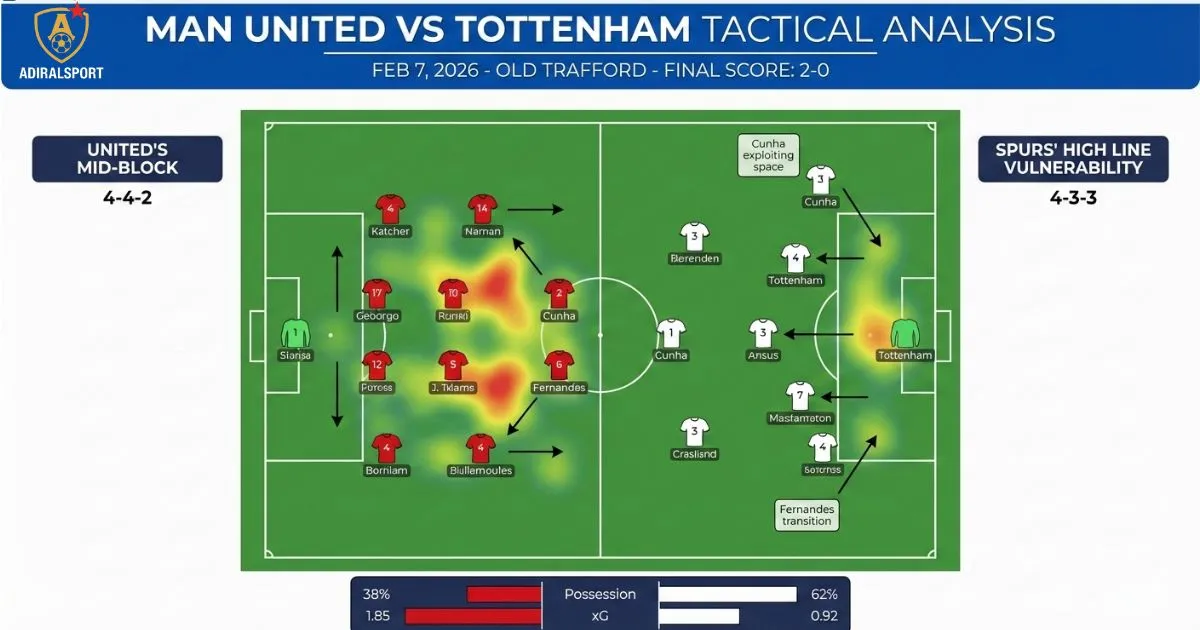
You might have been surprised to see Lammens retain his spot, but his ability to clip mid-range passes was crucial. Carrick set up a 4-2-3-1 that morphed into a rigid 4-4-2 out of possession. The key to this Man United vs Tottenham Tactical Analysis lies in the positioning of Matheus Cunha, who operated more as a second #10 than a traditional winger, overloading the central areas.
Tottenham Hotspur (4-3-3 / 3-2-5 in possession)
Starting XI:
- GK: Guglielmo Vicario
- DEF: Archie Gray, Cristian Romero, Micky van de Ven, Destiny Udogie
- MID: Yves Bissouma, Pape Matar Sarr, Xavi Simons
- FWD: Wilson Odobert, Dominic Solanke, Mohammed Kudus
Tactical Note:
Postecoglou stuck to his guns. Archie Gray inverted from right-back to join the midfield, pushing Xavi Simons high into the half-spaces. However, as we will explore, this aggressive positioning left massive gaps in transition.
Detailed Man United vs Tottenham Tactical Analysis
Now, let’s get into the granular details. If you want to understand why United won, you have to look at three specific battlegrounds.
The Battle for Midfield Control
The most fascinating aspect of today’s game was how United neutralized Tottenham’s numerical advantage in the center. On paper, Spurs’ inverted full-backs should have overwhelmed Casemiro and Mainoo. But that didn’t happen. Why?
Carrick’s instructions were disciplined. Instead of chasing the ball, you saw United’s double pivot sit deep, screening the back four. When Archie Gray inverted, Mainoo didn’t track him man-for-man; instead, he held his zone, allowing United’s wingers (Amad and Cunha) to pinch inside and clutter the passing lanes. This forced Spurs to play wide to their wingers, Odobert and Kudus, who were then isolated 1v1 against Dalot and Shaw.
In this Man United vs Tottenham Tactical Analysis, it is vital to note that United’s “cage” around Xavi Simons was executed to perfection. Every time Simons received the ball, he was immediately pressed from two angles, forcing him backward.
Exploiting the High Line
You know the drill with Ange’s Spurs: they play a high line. A very high line. The average defensive depth for Tottenham was 48 meters from their own goal. United knew this and prepared a trap.
Rather than playing long balls over the top blindly, United used bait. They would play short passes at the back to draw the Spurs press in, and then quickly switch play to the flanks. With Porro (or Gray) inverted and Udogie pushing high, the channels were wide open.
- The Data: United completed 8 successful through-balls today, their highest tally of the 2025/2026 season.
- The Visual: Picture the first goal. As soon as Casemiro won the ball, three United players sprinted away from the ball, dragging the Spurs defenders deep and creating a pocket of space for Bruno Fernandes.
Any Man United vs Tottenham Tactical Analysis worth its salt must highlight Micky van de Ven. If not for his recovery pace, which denied Amad Diallo twice, the scoreline could have been embarrassing for the visitors.
Xavi Simons vs. Kobbie Mainoo
Individual duels often decide tactical systems. The standout battle was between the dynamic Xavi Simons and the composed Kobbie Mainoo.
Simons, playing as the advanced 8, tried to drift between the lines to receive the ball on the half-turn. Mainoo’s job was to stop him. And stop him he did. You could see Mainoo physically checking his shoulder constantly, ensuring he blocked the passing lane to Simons. When the ball did reach the Dutchman, Mainoo was aggressive, winning 7 out of 9 ground duels.
By nullifying Spurs’ primary creator, United severed the link between midfield and attack. This individual matchup dictated the flow of the game and is a central pillar of our Man United vs Tottenham Tactical Analysis.
Statistical Breakdown (2025/2026 Season)
Sometimes, your eyes can deceive you, but the numbers rarely lie. The statistics from this match paint a clear picture of efficiency versus volume.
Match Statistics Table
| Statistic | Manchester United | Tottenham Hotspur |
| Goals | 2 | 0 |
| xG (Expected Goals) | 1.85 | 0.92 |
| Possession | 38% | 62% |
| Shots (On Target) | 14 (6) | 11 (3) |
| Pass Accuracy | 82% | 89% |
| Big Chances Created | 4 | 1 |
| Corners | 5 | 9 |
| Interceptions | 18 | 7 |
When you look at this table, the disparity in “Big Chances Created” is shocking. Spurs had the ball (62% possession), but they did very little with it. United, with only 38% possession, created four clear-cut opportunities. This efficiency is the recurring theme in our Man United vs Tottenham Tactical Analysis. United didn’t need the ball to control the game; they controlled the space.
Defensive Organization: Carrick vs. Ange
The contrast in managerial philosophies was stark. If you appreciate defensive structure, you would have loved what Carrick did today.
United’s Rigid Shape
Out of possession, United dropped into a 4-4-2. Bruno Fernandes pushed up alongside the striker (Mbeumo/Sesko) to press the Spurs center-backs gently, preventing them from carrying the ball forward comfortably.
The real stars, however, were the back four. Harry Maguire, enjoying a renaissance in the 2025/26 season, was imperious. He won 5/5 aerial duels. When Spurs resorted to crossing the ball because they couldn’t play through the middle, Maguire was there to clear it every single time. In this Man United vs Tottenham Tactical Analysis, we see how United forced Spurs into harmless cross-field passes rather than penetrating balls, effectively winning the game without the ball.
Spurs’ Vulnerability in Transition
On the other hand, you saw the same old issues for Tottenham. When they lost the ball, the gap between Cristian Romero and the midfield was massive—often referred to as “Zone 14.”
Because Bissouma was often positioned high to sustain attacks, there was no screen for the defense when possession turned over. Bruno Fernandes feasted in this space. He received the ball on the half-turn multiple times, facing a retreating defense that was terrified of his passing range. The most damning part of this Man United vs Tottenham Tactical Analysis is Spurs’ inability to stop the counter-press; once their initial wave of pressure was broken, they looked completely disorganized.
Player Ratings & Key Performances
How did the players fare in this tactical battle? Here is how you might rate the key protagonists.
Man of the Match: Matheus Cunha (8.5/10)
Role: Left-wing playmaker.
Cunha was everywhere. He started on the left but ended up dictating play centrally. With 1 assist and 3 key passes, he was the difference-maker. Gary Neville on Sky Sports put it best: “Cunha is the engine of this new United.”
Flop of the Match: Yves Bissouma (5.0/10)
Role: Defensive Midfield.
It was a tough afternoon for Bissouma. He was caught in possession twice, leading to dangerous counters, and failed to track the runs of Fernandes. His lack of discipline is a critical failure point in our Man United vs Tottenham Tactical Analysis.
Honorable Mention: Senne Lammens (7.5/10)
The young goalkeeper was calm under pressure, acting as an eleventh outfield player during the build-up phase.
Conclusion / Man United vs Tottenham Tactical Analysis
So, what have we learned from this afternoon at Old Trafford?
Michael Carrick has seemingly solved the defensive fragility that plagued the Amorim era. By prioritizing shape over possession and efficiency over flair, he has made United a difficult team to beat. For Tottenham, the “Angeball” philosophy faces fresh scrutiny. As they slip to 14th in the table, you have to wonder if the refusal to adapt is costing them points in big games.
This match wasn’t just a win; it was a statement. It proved that pragmatic football, executed well, can dismantle idealistic attacking structures in 2026. This Man United vs Tottenham Tactical Analysis highlights that while football is often about romance, it is ultimately decided by who makes fewer mistakes.
What do you think? Was Carrick right to cede possession? Or are Spurs just unlucky? Let us know your thoughts on the tactics in the comments below.
FAQ: Man United vs Tottenham Tactical Analysis
Q1: Who was the standout player in this Man United vs Tottenham Tactical Analysis?
A: Without a doubt, Matheus Cunha was the standout. His ability to drift inside and operate as a secondary playmaker provided the creative spark United needed, including the assist for the opening goal.
Q2: Why did Tottenham lose despite having more possession?
A: As detailed in our Man United vs Tottenham Tactical Analysis, possession without penetration is futile. United’s low block forced Spurs into wide areas where they were ineffective, while United capitalized on high-quality chances on the break.
Q3: What formation did Michael Carrick use?
A: Carrick utilized a 4-2-3-1 that shifted into a compact 4-4-2 defensively. This shape was crucial for denying space between the lines, a key point in this Man United vs Tottenham Tactical Analysis.
Q4: Is this the first time Carrick has beaten Postecoglou?
A: Yes, this Man United vs Tottenham Tactical Analysis marks Michael Carrick’s first head-to-head win over Ange Postecoglou as Manchester United manager, signaling a potential turning of the tide in this rivalry.
Q5: Where can I find more stats for this match?
A: You can find a full statistical breakdown in the table included in the “Statistical Breakdown” section above.