
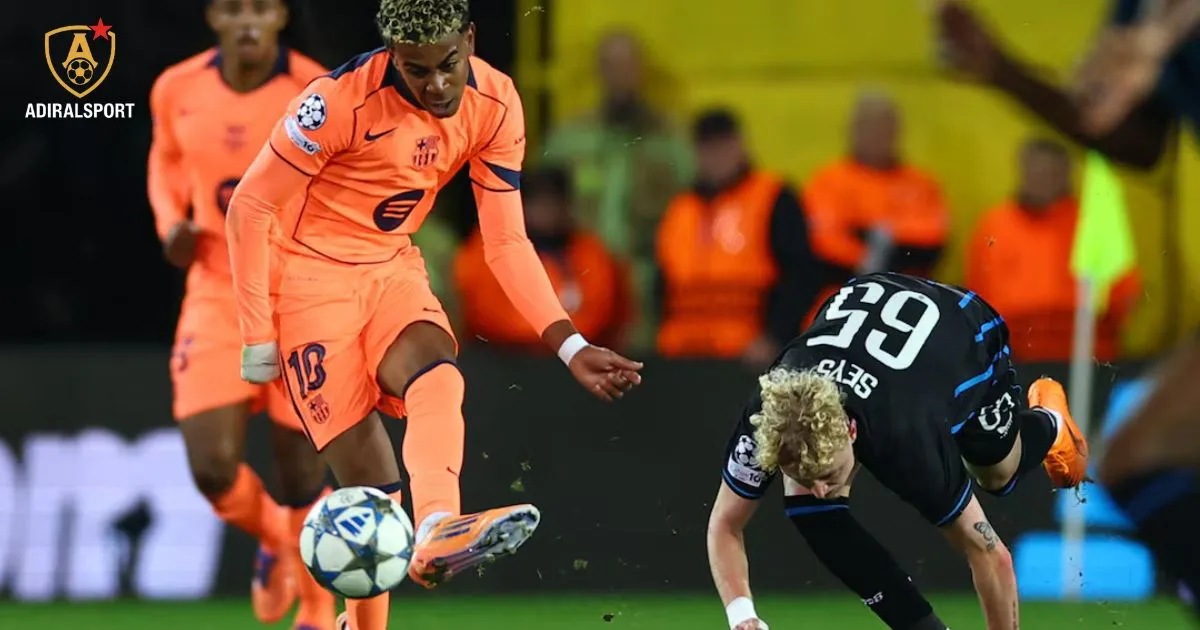
Club Brugge vs FC Barcelona Tactical Analysis
Table of Contents
Club Brugge vs FC Barcelona Tactical Analysis: A 3-3 Champions League Thriller Dissected
An Opening for the Fans: The Beautiful Chaos of a 3-3 Draw
You watch football for the feeling, don’t you? It’s not just about the 90 minutes; it’s about the gut-wrenching tension, the explosion of joy when the net ripples, and the sinking despair of a last-minute defensive lapse. It’s an emotional contract you sign every time you sit down to watch your team.
And what you witnessed on November 5, 2025, at the Jan Breydel Stadion was the entire spectrum of footballing emotion compressed into one night of beautiful, terrifying chaos.
This Club Brugge vs FC Barcelona tactical analysis is more than just a match report. It’s a deep dive into a game that defied logic. How, you must be asking, can a team like FC Barcelona hold 76% possession, complete over 735 passes, and still look so frighteningly vulnerable? Conversely, how did Club Brugge, with just 24% of the ball, manage to surgically dismantle one of Europe’s elite, not once, not twice, but three separate times?
This wasn’t just a 3-3 draw; it was a philosophical clash. It was Hansi Flick’s high-line idealism against Brugge’s counter-attacking pragmatism. If you’ve ever felt the frustration of watching your team dominate the ball but lose the war, this game was your nightmare—and your validation—all at once. We’re going to break down the why behind the madness, dissecting every crucial decision and structural flaw. This is the definitive Club Brugge vs FC Barcelona tactical analysis of that six-goal classic.
Match at a Glance: The Final Score & Key Statistics
Before your heart rate starts to climb again just thinking about the game, let’s ground ourselves in the raw data. The numbers from this UEFA Champions League 2025/2026 League Phase match tell a story of two different worlds colliding. On one side, you have Barcelona’s overwhelming dominance of the ball. On the other, you have a staggering, almost unbelievable equality in the only metric that truly matters: efficiency.
Final Scoreboard & Match Details
- Competition: UEFA Champions League (2025/2026 Season, League Phase Matchday 4)
- Match: Club Brugge vs FC Barcelona
- Final Score: 3 – 3
- Venue: Jan Breydel Stadion, Bruges
- Date: November 5, 2025
- Man of the Match: Carlos Forbs (Club Brugge)
Full-Time Statistics Table: A Tale of Two Strategies
When you look at this table, your eyes are immediately drawn to the possession numbers. 76% to 24% is not just dominance; it’s a statistical monopoly. But look closer. This is where our Club Brugge vs FC Barcelona tactical analysis truly begins.
| Statistic | Club Brugge | FC Barcelona |
| Possession % | 24% | 76% |
| Total Shots | 10 | 23 |
| Shots on Target | 6 | 6 |
| Passes | 230 | 735 |
| Pass Accuracy % | 73% | 92% |
| Corners | 0 | 4 |
| Fouls Committed | 11 | 6 |
| Yellow Cards | 2 | 3 |
| Woodwork Hit | 0 | 3 |
| xG (Expected Goals) | 2.14 | 2.14 |
The Most Important Stat: xG (2.14 vs 2.14)
This is it. This is the key. Forget the 76% possession. The Expected Goals (xG) for both teams was identical.
What does this tell you? It tells you that for all of Barcelona’s 735 passes, for all their sterile control, they created chances of the same quality and quantity as a team that barely saw the ball. This Club Brugge vs FC Barcelona tactical analysis isn’t a story of “wasteful Barça” versus “clinical Brugge.” It’s the story of two teams creating an equal amount of danger, just in completely opposite ways.
Brugge did it with a scalpel, generating 2.14 xG from 10 shots. Barcelona did it with a sledgehammer, needing 23 shots (and hitting the woodwork three times!) to generate the exact same 2.14 xG. This statistical anomaly is the heart of our entire analysis.
The Teams: Starting Lineups and Formations
On paper, you might have seen this matchup and expected a simple 4-2-3-1 mirror match. Both managers, Hansi Flick and his counterpart, sent their teams out in what looked like the same shape. But as you quickly discovered, the interpretation of that 4-2-3-1 was as different as night and day.
Club Brugge Starting XI (4-2-3-1): The Coiled Spring
- Goalkeeper: N. Jackers
- Defenders: K. Sabbe, J. Ordoñez, B. Mechele, J. Seys
- Midfield Pivot: A. Stanković, R. Onyedika
- Attacking Midfield: C. Forbs (RW), H. Vanaken (CAM), C. Tzolis (LW)
- Striker: N. Tresoldi
The Tactic: Your first glance at this lineup reveals its true purpose. This was never a team sent out to compete for the ball. This was a team designed to react.
When you watched them without the ball, they didn’t even hold a 4-2-3-1. They collapsed into a rigid, compact 4-4-2 low block. The entire plan, which this Club Brugge vs FC Barcelona tactical analysis must praise, was built on three pillars:
- Defensive Discipline: The back four and midfield four would stay within yards of each other, denying any space between the lines for Fermín López or Frenkie de Jong.
- The ‘Destroyers’: Onyedika and Stanković were not on the field to pass. They were there to tackle, intercept, and destroy. Onyedika, in particular, was immense in breaking up play.
- The ‘Outlet’: The second a tackle was won, the plan was to bypass the midfield entirely and find Carlos Forbs or Christos Tzolis. This was a side built to absorb pressure and then explode, and it worked to perfection.
FC Barcelona Starting XI (4-2-3-1): The Possession-Hungry Beast
- Goalkeeper: W. Szczęsny
- Defenders: J. Koundé, R. Araújo, E. García, A. Balde
- Midfield Pivot: M. Casadó, F. de Jong
- Attacking Midfield: L. Yamal (RW), F. López (CAM), M. Rashford (LW)
- Striker: F. Torres
The Tactic: Hansi Flick’s philosophy was written all over this team sheet. This was a side designed to control 100% of the game.
- The High Line: With Araújo and García, both ball-playing defenders, you were guaranteed a defensive line that would live on the halfway circle. This is fundamental to Flick’s system, as it compresses the pitch and aids the counter-press. As you saw, however, it’s also a massive risk.
- The Double Pivot: You might have been surprised to see Marc Casadó start, but his inclusion alongside Frenkie de Jong was a clear signal. Flick wanted two technically-secure players to build up play from the back, recycle possession, and ensure the 76% possession stat was a reality.
- The ‘System’ vs. ‘Individuals’: Up front, the inclusion of Marcus Rashford and Lamine Yamal provided explosive 1-v-1 talent, while Ferran Torres and Fermín López were there to make intelligent runs and link play. The idea was to use overwhelming possession and individual brilliance to break down Brugge’s inevitable low block.
The problem, as this Club Brugge vs FC Barcelona tactical analysis will show, is what happened when that high-possession machine stalled.
Timeline of a Thriller: How the 3-3 Unfolded / Club Brugge vs FC Barcelona Tactical Analysis
You couldn’t even catch your breath. This game didn’t ease you in; it threw you straight into the fire. The match was a story of “punch, counter-punch, counter-punch,” with Barcelona constantly trying to fix the problems their own system created.
- 6′ – GOAL! (Brugge 1-0 Barça): You’ve barely settled in. Barcelona lose the ball high up the pitch. It’s the exact scenario Brugge trained for. One pass breaks the entire press. Carlos Forbs is electric, he ghosts past his man and squares it for Nicolò Tresoldi. It’s a simple tap-in. The Jan Breydel Stadion explodes. Barcelona’s high line is exposed in under 360 seconds.
- 8′ – GOAL! (Brugge 1-1 Barça): An instant response. This is what great teams do. There’s no panic. The ball is worked to Fermín López, who finds Ferran Torres. It’s a sharp finish. You think, “Okay, anomaly over. Normal service resumed.” You were wrong.
- 17′ – GOAL! (Brugge 2-1 Barça): It happens again. It’s almost an action replay of the first goal, but this time the creator becomes the finisher. Another turnover, another long ball that completely bypasses Barça’s midfield. Carlos Forbs—the man of the match—is simply too fast. He latches onto a pass from Tzolis, and with Araújo scrambling, he finishes with chilling composure.
- 58′ – Barça Subs: Flick has seen enough. He makes the aggressive double change: Robert Lewandowski & Dani Olmo ON; Ferran Torres & Marc Casadó OFF. This is a clear signal: less control, more pure firepower.
- 61′ – GOAL! (Brugge 2-2 Barça): Individual magic. When the system fails, you need a genius. Lamine Yamal provides the moment. He gets the ball, combines beautifully with Fermín López (who provides a deft back-heel), and slots it past Jackers. A brilliant, brilliant goal that has nothing to do with the team’s broader tactics.
- 63′ – GOAL! (Brugge 3-2 Barça): You cannot be serious. Just two minutes later. Barcelona are celebrating, their guard is down, and Brugge do it again. A simple long ball from Hans Vanaken. Carlos Forbs again. He dinks it beautifully over the onrushing Szczęsny. It’s 3-2. This Club Brugge vs FC Barcelona tactical analysis must note the sheer defensive fragility. It’s unbelievable.
- 77′ – GOAL! (Brugge 3-3 Barça): The cruelest of goals. Barcelona are throwing everything forward. Yamal, again, is the danger man. He whips in a cross. Christos Tzolis, who had been so good, tries to clear it and heads it straight into his own net. A heartbreaking moment that levels the game for the third and final time.
- 90’+1′ – VAR DRAMA: Your heart stops. A scramble in the Barça box. Szczęsny is robbed of the ball by Romeo Vermant, who taps it into the empty net. The stadium erupts. It’s 4-3. It’s a historic win. But wait. VAR. The replay shows Vermant tripped the goalkeeper. The goal is disallowed. Barcelona are saved by the whistle.
The Core Tactical Battle: Barcelona’s Possession vs. Brugge’s Precision / Club Brugge vs FC Barcelona Tactical Analysis
This is the most critical section of our Club Brugge vs FC Barcelona tactical analysis. This game was a philosophical war. It was about how you choose to win a football match. Do you control the ball, or do you control the spaces that matter?
Brugge’s Counter-Attacking Masterclass
You have to give credit where it’s due. This was not “park the bus.” This was “park the bus, and rig it with explosives.” It was a masterpiece of reactive football, and every single player understood their role.
The 4-4-2 ‘Zonal’ Low Block
When you re-watch the game, pause it any time Barcelona has the ball in the middle third. You will see two perfectly straight, incredibly narrow banks of four.
- No Space Between the Lines: The primary objective was to deny any passes to Fermín López. By keeping the defensive and midfield lines close, they forced Barça to play the ball wide.
- The “U-Shape” Trap: Brugge wanted Koundé to pass to Araújo, who passed to García, who passed back to de Jong, who passed back to Araújo. They were happy to let you have 76% possession as long as it was in a harmless “U-shape” around their block.
- Seys & Sabbe’s Role: The full-backs, Joaquin Seys and Kyriani Sabbe, were phenomenal. Their instruction was clear: let Yamal and Rashford have the ball in front of you, but never let them get in behind. Seys, in particular, was a tackling machine, winning 5 tackles.
The ‘Trigger’ and The ‘Outlet’
This is what separates a good defensive team from a great counter-attacking one.
- The Trigger: The “trigger” for the attack was any pass won by Onyedika or Stanković. The moment they won a duel, they were under strict orders not to play a simple, safe pass.
- The Outlet: Their first look was always the same: a long, diagonal, or straight ball into the channels for Carlos Forbs or Christos Tzolis. They completely bypassed the midfield, turning a defensive action into a 2-v-2 or 3-v-2 situation against Barcelona’s high line. All three of their goals came from this exact pattern.
This Club Brugge vs FC Barcelona tactical analysis confirms their game plan was not just to “survive,” but to “lure and strike.”
Barcelona’s High-Line Problems and Attacking Patterns
For you, as a Barcelona follower, this game must have been infuriating. You saw your team completely control the game… and yet, they were never in control. This is the paradox of Hansi Flick’s system.
Dominance in Vain: The 76% Possession Trap
What is the point of 735 passes if they don’t lead to victory?
- Sterile Possession: Frenkie de Jong, while brilliant with a 92%+ pass accuracy, was often reduced to recycling the ball side-to-side. You could see his frustration. Brugge’s block was so well-organized that the only “free” players were the center-backs.
- The Individual Burden: Because the system was struggling to create openings, the burden fell on individuals. You saw Lamine Yamal (who completed 5 dribbles) and Marcus Rashford constantly trying to beat their man 1-v-1, because it was the only way through.
- Hitting the Woodwork… Three Times: Koundé, Fermín, and Eric García all hit the frame of the goal. On another night, Barça win 6-3. But you can’t blame luck. This was a symptom of the problem: when you’re reduced to long-range shots (García) or half-chances in a crowded box, you’re relying on variance. This Club Brugge vs FC Barcelona tactical analysis sees this as a sign of a dysfunctional attack, not bad luck.
The High Line: A Philosophy on the Brink of Collapse
This is the central flaw. Hansi Flick, in his post-match comments, confirmed he will not change this, but you have to wonder why.
- The Fatal Space: Flick’s system demands the center-backs (Araújo and García) defend on the halfway line. This is essential for the gegenpress (counter-press).
- The Problem: The press wasn’t working. As Flick himself said, “There was no intensity, we didn’t win duels.”
- The Result: When your high press fails and you lose the ball, your high line is no longer a tool of aggression; it’s a suicidal liability. There is 50 yards of open grass behind your defenders.
- Forbs’ Playground: Carlos Forbs (2 goals, 1 assist) didn’t just play well; he was the direct beneficiary of this tactical flaw. He wasn’t even “on” the last defender; he was 10 yards off him, waiting for the triggered pass to be played into the space he knew would be there. This Club Brugge vs FC Barcelona tactical analysis identifies this as the single biggest tactical failure of the night for Barcelona.
A Deeper Look: The Midfield Battle (Destroyers vs. Controllers)
If you wanted to see the game’s entire story in one matchup, you just had to watch the two midfield pivots. This part of the Club Brugge vs FC Barcelona tactical analysis is crucial.
- Brugge’s ‘Destroy and Launch’ Duo:
- Raphael Onyedika & Aleksandar Stanković: Their job was simple: be a wall. They completed very few passes. They didn’t have to. Their success was measured in tackles, interceptions, and duels won. Onyedika was a monster, breaking up play and immediately giving the ball to Vanaken, who would launch the counter.
- Barça’s ‘Control vs. Creation’ Dilemma:
- Frenkie de Jong & Marc Casadó: De Jong had the most touches of anyone on the pitch. He was the metronome, trying to find a rhythm. But he was playing against a brick wall. Casadó, a young player with immense talent, was simply overwhelmed. He was tasked with both controlling possession and covering the space for Balde’s overlapping runs, and helping to stop the counter. It was an impossible job, and it’s why Flick subbed him at 58 minutes. This matchup was the perfect summary: Brugge’s midfield succeeded at its simple, destructive job, while Barcelona’s midfield failed at its complex, creative one.
Conclusion: A Point Gained or Two Points Dropped? / Club Brugge vs FC Barcelona Tactical Analysis
So, as the dust settles on this chaotic 3-3, what are you left with? This Club Brugge vs FC Barcelona tactical analysis ends with two very different truths.
For Club Brugge, this is a victory in all but name.
They took a point from a European giant, but more importantly, their tactical plan was a resounding success. They were disciplined, brave, and absolutely lethal. They exposed a fundamental weakness in Barcelona’s system and exploited it three times. You can only imagine their frustration with the 90+1′ VAR call, which was the only thing standing between them and a historic victory. This Club Brugge vs FC Barcelona tactical analysis will be studied by their coaches as a near-perfect execution of a plan.
For FC Barcelona, this is two points dropped, and a flashing red warning light.
You cannot concede three identical counter-attacking goals and expect to win the Champions League. Hansi Flick’s post-match comments about a “lack of intensity” and “not winning duels” are a direct criticism of his players, but this Club Brugge vs FC Barcelona tactical analysis must also question the system.
A high line without a high-functioning press is not aggressive; it’s just naïve.
Barcelona’s 76% possession was a meaningless number. They were saved by a moment of individual genius from Lamine Yamal and a heartbreaking own goal. This 3-3 draw was thrilling, dramatic, and a fantastic spectacle for the neutral. But for you and for Hansi Flick, it should be a wake-up call. Possession is not control. And until Barcelona learns to control the chaos they create, nights like this will happen again.
What was your biggest takeaway from this match? Did you see it as a point gained for Barça or two points dropped? Drop your own Club Brugge vs FC Barcelona tactical analysis in the comments below!
FAQs: Club Brugge vs FC Barcelona Tactical Analysis (2025/2026)
Q1: What was the main tactical takeaway from this Club Brugge vs FC Barcelona tactical analysis?
A: The main takeaway is that a high-possession, high-line system is incredibly vulnerable if it’s not paired with a perfect, high-intensity counter-press. This Club Brugge vs FC Barcelona tactical analysis showed that Brugge (with just 24% possession) could generate the exact same quality of chances (2.14 xG) as Barcelona (76% possession, 2.14 xG) simply by absorbing pressure and attacking the massive space left behind Barça’s high defensive line.
Q2: Who was the key player in this Club Brugge vs FC Barcelona tactical analysis?
A: Without a doubt, Carlos Forbs. He was named UEFA’s Man of the Match, and this Club Brugge vs FC Barcelona tactical analysis confirms it. He was the living embodiment of Brugge’s game plan. With two goals and one assist, his electric pace and intelligent movement were the weapons used to exploit Barcelona’s high line. He didn’t just play well; he was the tactical key that unlocked the entire game for Brugge.
Q3: Why did Barcelona struggle despite having 76% possession?
A: Your frustration is valid. They struggled because their possession was “sterile.” Brugge’s compact 4-4-2 low block allowed Barcelona to have the ball in non-dangerous areas (a “U-shape” between their center-backs and de Jong). This Club Brugge vs FC Barcelona tactical analysis found that Barça lacked the systemic creativity to break this block down, forcing them to rely on 1-v-1 magic from Lamine Yamal or long shots. Defensively, their own manager, Hansi Flick, said they “lost the duels” and “lacked intensity,” which meant their high line was left completely exposed.
Q4: How did the substitutions impact this Club Brugge vs FC Barcelona tactical analysis?
A: The substitutions were a major factor in the second half. Hansi Flick’s double change at 58 minutes (Lewandowski & Olmo ON for Torres & Casadó) was a clear admission that the “control” experiment with Casadó had failed. He went for broke, adding more pure attacking talent. This added pressure and a more direct threat, which this Club Brugge vs FC Barcelona tactical analysis believes directly contributed to the fatigue and panic that led to the 77th-minute own goal. It was a necessary, reactive move that salvaged a point.