
Man City VS Sunderland Tactical Analysis
Table of Contents
Man City VS Sunderland Tactical Analysis: How Defenders & Creative Brilliance Shattered the Black Cats’ Resistance
You know that feeling. The one where you’re watching a game, and for the first thirty minutes, it feels like you’re watching a master painter staring at a blank canvas, waiting for inspiration to strike. That was the Etihad Stadium this Saturday afternoon. You could feel the tension radiating from the stands—not panic, but a simmering anxiety. Manchester City, fresh off that chaotic 5-4 rollercoaster against Fulham, needed stability. Sunderland, the season’s surprise package under Regis Le Bris, arrived with a game plan so rigid it looked like they were trying to park a double-decker bus in front of Robin Roefs.
But football has a funny way of rewarding patience. Just when you thought the stalemate would drag into halftime, the script flipped. It wasn’t the usual suspects like Haaland or Foden who cracked the code initially; it was the backline stepping into the limelight. If you missed the nuance of how Guardiola’s men dismantled this disciplined low block, you’ve come to the right place. This Man City VS Sunderland Tactical Analysis dives deep into the chess match that unfolded on December 6, 2025, dissecting how a 3-0 victory was anything but straightforward.
1. The Setup: Lineups and Initial Formations
To truly grasp the dynamics of this match, you first need to look at the teamsheets. The decisions made by Guardiola and Le Bris before a ball was kicked defined the entire first half narrative.
Manchester City’s Shape (4-2-3-1)
Guardiola tweaked his system. You might have expected the usual 4-3-3, but he opted for a double pivot, likely to protect against Sunderland’s transitions which had stunned Liverpool just days prior.
- Goalkeeper: Gianluigi Donnarumma
- Defenders: Matheus Nunes (Inverted RB), Ruben Dias, Josko Gvardiol, Nico O’Reilly
- Midfield: Nico González, Bernardo Silva (C)
- Attack: Rayan Cherki, Phil Foden, Jérémy Doku
- Striker: Erling Haaland
The inclusion of Nico González was pivotal. He offered a physical shield, allowing Bernardo Silva to dictate tempo without worrying about defensive cover.
Sunderland’s Fortress (5-4-1)
Regis Le Bris didn’t hide his intentions. He set up to frustrate.
- Goalkeeper: Robin Roefs
- Defenders: Trai Hume, Nordi Mukiele, Dan Ballard, Omar Alderete, Lutsharel Geertruida
- Midfield: Ismaël Koné, Granit Xhaka, Noah Sadiki, Enzo Le Fée
- Forward: Wilson Isidor
When you look at this setup in our Man City VS Sunderland Tactical Analysis, you see a clear intent: deny space centrally. For the first half-hour, it worked perfectly.
2. Suffocating the Space: Sunderland’s Defensive Discipline
For the opening 30 minutes, you were watching a defensive clinic. Sunderland’s 5-4-1 wasn’t just a formation; it was a moving organism. Every time Phil Foden or Rayan Cherki tried to drift inside, they were met by a swarm of red and white shirts.
The Midfield Cage
Sunderland’s trio of Xhaka, Sadiki, and Koné stayed incredibly narrow. Their job was simple: force City wide. And it worked. You saw Doku receiving the ball on the touchline time and again, only to be doubled up by Trai Hume and Ismaël Koné.
- City’s Frustration: You could see Haaland dropping deeper and deeper, trying to touch the ball. This is exactly what Le Bris wanted—the most dangerous striker in the world, 40 yards from goal.
- The Trap: By clogging the center, Sunderland invited City’s full-backs to cross. With three center-backs (Mukiele, Ballard, Alderete) dominating the air, crosses were food and drink to them.
In any standard Man City VS Sunderland Tactical Analysis, this phase would be highlighted as a defensive success for the visitors. They nullified the creative threat of Foden completely in the opening exchanges.
3. The Breakthrough: When Defenders Become Attackers
So, how do you break a block that refuses to budge? You change the variables. If the attackers are marked out of the game, the defenders must become the spare men. This is where the match turned, and it’s a crucial point in our Man City VS Sunderland Tactical Analysis.
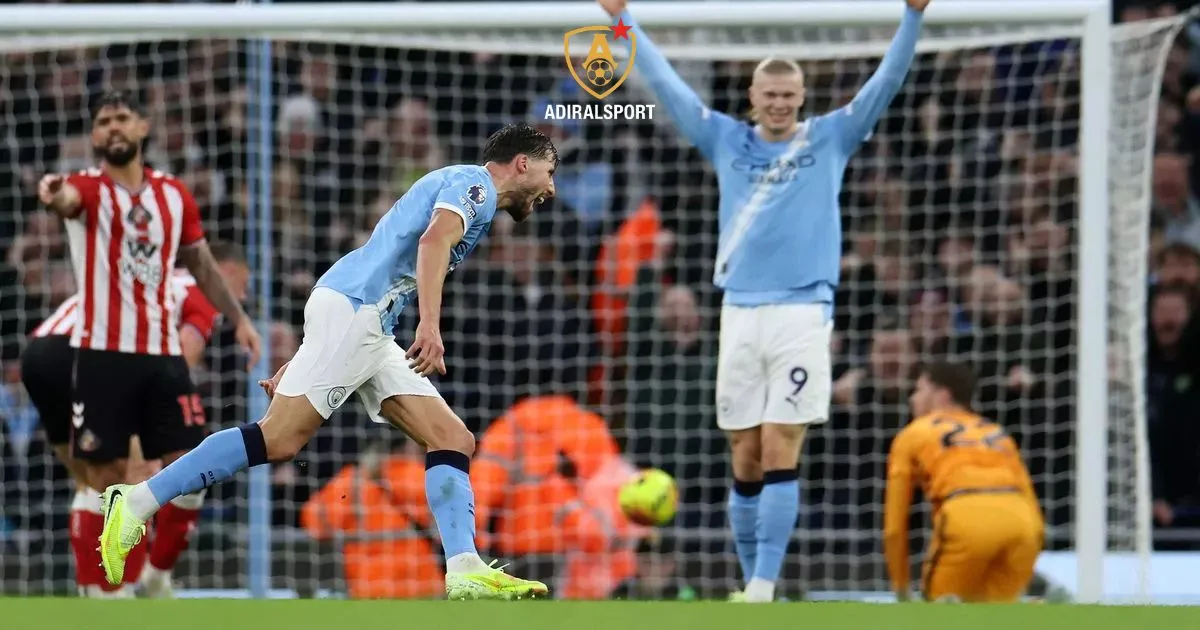
Ruben Dias Shatters the Glass (31′)
It happened in a flash. Sunderland’s strikers dropped deep to shadow Nico González, assuming he was the pivot point. This left Ruben Dias with acres of space to drive into.
Usually, a center-back would pass sideways. You’ve seen it a thousand times. But Dias, sensing the stagnation, took matters into his own hands. He drove forward, ignored the passing options, and unleashed a thunderbolt from 25 yards. The ball screamed past Roefs into the top corner.
Key Tactical Shift: Dias stepping out of defense forced a Sunderland midfielder to engage him. This broke their rigid lines for the first time. Once that structure fractured, panic set in.
Gvardiol Doubles Down (35′)
Barely four minutes later, the game was effectively over. A corner from the right found Josko Gvardiol. Sunderland, perhaps still reeling from the shock of the first goal, failed to track his run. His header was emphatic.
When you read a Man City VS Sunderland Tactical Analysis, you often look for complex passing patterns. But here, the difference was raw individual quality from City’s defenders. They provided the goals when the attackers were stifled.
4. The Second Half: Magic and Control
Leading 2-0, the dynamic shifted. City didn’t need to force the issue, and Sunderland had to abandon their low block. This opened the game up, allowing City’s creative players to finally breathe.
The “Rabona” Moment (66′)
If the first half was about grit, the second was about glitter. The third goal was a masterpiece that will be replayed in highlight reels for years.
- Isolation: Rayan Cherki found himself 1v1 on the right edge of the box.
- The Audacity: Instead of a predictable cross, he wrapped his kicking leg behind his standing leg—a Rabona.
- The Execution: The chip floated perfectly to the back post where Phil Foden was waiting to nod it home.
This goal exemplifies the difference in class. In this Man City VS Sunderland Tactical Analysis, it serves as the moment the Black Cats’ spirit finally broke. You cannot legislate for genius like that.
5. Sunderland’s Counter-Attacking Woes
It would be unfair to say Sunderland offered nothing. In fact, early in the second half, they nearly flipped the script.
The Sliding Doors Moment
Just minutes after the restart, Granit Xhaka found space on the edge of the box. His low drive beat Donnarumma but rattled the post.
- What if? If that goes in, it’s 2-1, and the nerves return to the Etihad.
- The Issue: Apart from that moment and isolated runs by Wilson Isidor, Sunderland lacked an outlet. Isidor had only 18 touches in the first hour. When you are playing against City, your outlet ball has to stick. Today, it didn’t.
Our Man City VS Sunderland Tactical Analysis highlights this as the primary failure for Le Bris: the inability to transition effectively from defense to attack against City’s counter-press.
6. Statistical Deep Dive
Numbers don’t lie, and they paint a stark picture of dominance in this match.
| Statistic | Manchester City | Sunderland |
| Goals | 3 | 0 |
| Possession | 66% | 34% |
| Total Shots | 18 | 6 |
| Shots on Target | 7 | 2 |
| Expected Goals (xG) | 2.45 | 0.68 |
| Pass Accuracy | 91% | 81% |
| Corners | 8 | 3 |
| Big Chances Created | 4 | 1 |
Looking at these stats within the context of a Man City VS Sunderland Tactical Analysis, the xG (Expected Goals) is telling. City created high-quality chances (2.45), mostly after the first goal forced Sunderland to open up. Sunderland’s 0.68 suggests they rarely threatened the City goal, Xhaka’s chance aside.
7. Player Focus: The Game Changers
While the team structure was vital, individual performances defined the outcome.
Phil Foden (Man City)
- Role: Roaming Playmaker.
- Stats: 1 Goal, 1 Assist, 4 Key Passes.
- Analysis: Foden was the ghost in the machine. He constantly drifted into the “half-spaces” between Sunderland’s wing-backs and center-backs. His movement is a nightmare to mark because he never stands still.
Nico González (Man City)
- Role: The Anchor.
- Stats: 94% Pass Accuracy, 4 Interceptions, 3 Tackles.
- Analysis: Stepping in for Rodri is the hardest job in football. González made it look easy. His physical presence stopped Sunderland’s counters before they could even cross the halfway line. In any Man City VS Sunderland Tactical Analysis, his contribution cannot be overlooked.
Dan Ballard (Sunderland)
- Role: Central Defender.
- Stats: 8 Clearances, 2 Blocks.
- Analysis: Despite the scoreline, Ballard was immense. He headed away almost everything City threw into the box in the first half. He was let down by the lack of protection ahead of him once the game opened up.
8. Tactical Timeline of the Match
To help you visualize the flow of the game, here is a breakdown of the key tactical events:
- 0-30′: The Standoff. City possesses, Sunderland holds the 5-4-1 shape. Zero clear chances.
- 31′: The Breaker. Ruben Dias scores from distance (1-0). Sunderland’s low block is rendered useless.
- 35′: The Blow. Gvardiol scores from a corner (2-0). Sunderland’s zonal marking collapses.
- 46-55′: The Response. Sunderland pushes higher. Xhaka hits the post. The game becomes stretched.
- 66′: The Silencer. Foden scores from Cherki’s rabona (3-0). Game over.
- 75-90′: Cruise Control. City keeps the ball, saving energy for the upcoming Champions League fixtures.
This timeline is essential for a complete Man City VS Sunderland Tactical Analysis, showing exactly where the game was won and lost.
9. Why City’s Adaptation Won the Day
The biggest takeaway for you from this match should be City’s adaptability. In previous seasons, City might have struggled against such a disciplined block, recycling the ball endlessly until frustration set in.
Today, they showed a different weapon: Long-range shooting and Set Pieces.
By scoring from outside the box (Dias) and from a corner (Gvardiol), they bypassed the need to pass through the 10 men Sunderland had behind the ball. Once they had the lead, the game played into their hands. This evolution is what makes them terrifying in the 2025/2026 season.
The Man City VS Sunderland Tactical Analysis proves that you can’t just have Plan A against Guardiola. You need to be perfect for 90 minutes. Sunderland was perfect for 30, and that wasn’t enough.
Conclusion / Man City VS Sunderland Tactical Analysis
In the end, the 3-0 scoreline feels fair, but it doesn’t tell the whole story of the tactical battle in the first half. You witnessed a Sunderland side that was well-drilled and stubborn, undone only by moments of individual brilliance that no system can account for.
For Manchester City, this performance was a statement. After the chaos of Fulham, this was control. It was professional. It was champion-quality. For Sunderland, there is no shame in this defeat. Their defensive structure is sound; they just met a team that has an answer for every question.
As we wrap up this Man City VS Sunderland Tactical Analysis, one thing is clear: if you want to beat City this season, sitting back and hoping for the best is no longer a viable strategy. You have to be brave, or they will simply shoot over your head.
Frequently Asked Questions (FAQ) / Man City VS Sunderland Tactical Analysis
Q1: What was the formation used by both teams?
A: As detailed in our Man City VS Sunderland Tactical Analysis, City played a 4-2-3-1 with inverted full-backs, while Sunderland utilized a defensive 5-4-1 low block.
Q2: Who was the standout player in the Man City VS Sunderland match?
A: Phil Foden took the headlines with a goal and an assist, but Ruben Dias was crucial for breaking the deadlock with his long-range strike.
Q3: Why did Sunderland struggle to create chances?
A: Sunderland’s striker, Wilson Isidor, was isolated. The gap between their midfield and attack was too large, and City’s counter-press (led by Nico González) suffocated their transition play.
Q4: How important was this win for Man City’s 2025/2026 season?
A: Vital. Coming off a 5-4 win against Fulham where they looked defensively shaky, this clean sheet restored confidence and control to their title charge.
Q5: Where can I find more tactical breakdowns like this?
A: Stay tuned to our blog for weekly deep dives, similar to this Man City VS Sunderland Tactical Analysis, covering all the big Premier League clashes.
Next Step for You / Man City VS Sunderland Tactical Analysis
Would you like me to create a training drill inspired by Man City’s “Defensive Overload” attack used in this match, to help your own team break down low blocks?