
PSG vs Bayern Munchen Tactical Analysis
Table of Contents
It’s more than just 90 minutes. When the floodlights of the Parc des Princes blaze to life and that iconic Champions League anthem swells, the air crackles. This isn’t just football; it’s a chess match played at 100 mph, a story of strategy, heart, and brutal momentum shifts. We all felt it on Tuesday night—the early Bavarian onslaught, the shock of the red card, and the desperate, suffocating pressure of a Parisian comeback.
You were probably on the edge of your seat, watching two of Europe’s titans throw everything they had at each other. Bayern’s 2-1 victory wasn’t just a win; it was a tactical statement, a lesson in resilience and flexibility. This PSG vs Bayern Munchen tactical analysis goes beyond the 1-2 scoreline. We’re here to dissect the managers’ game plans, the key moments that defined the match, and the numbers behind a classic European night. This is the story of how Vincent Kompany’s 10-man fortress withstood Luis Enrique’s siege, and what it tells you about the state of elite football in the 2025/2026 season.
The Pre-Match Battlefield: Setting the Stage
Before a ball was kicked, this Champions League Matchday 4 encounter was poised on a knife’s edge. You couldn’t have scripted a more dramatic setup. Both Paris Saint-Germain and FC Bayern Munich entered the Parc des Princes with perfect records in the group stage. This wasn’t just a match for points; it was a direct battle for control, for a psychological edge that would resonate deep into the knockout rounds.
- Form Guide: Both teams arrived with maximum points (nine from three). PSG had been rampant, scoring 13 goals, including a 7-2 demolition of Bayer Leverkusen. Bayern had been just as dominant, with 12 goals and only two conceded. You had two footballing juggernauts at the absolute peak of their powers.
- Managerial Philosophies: This game was a fascinating clash of managerial minds. On one side, you have Luis Enrique, a purist obsessed with Juego de Posición—high-pressing, suffocating possession, and intricate passing triangles. On the other, Vincent Kompany, a modern pragmatist who has instilled a new defensive discipline in Bayern, favoring organized, transition-heavy football that strikes with precision.
- Key Absences: The pre-match buzz was also dominated by who wasn’t playing. Bayern traveled to Paris without the creative force of Jamal Musiala and the blistering pace of Alphonso Davies, both sidelined with injuries. This forced Kompany to adjust, slotting Josip Stanišić into a more conservative left-back role and relying on Serge Gnabry’s experience in the central attacking midfield spot. For any other team, these would be crippling losses. For Bayern, it was just the first tactical problem to solve. This context is vital for any complete PSG vs Bayern Munchen tactical analysis.
Deconstructing the XIs: A Tactical Lineup Analysis
The starting lineups announced by Enrique and Kompany were the first moves in this tactical chess match. As soon as you saw the team sheets, you could see their intentions. The formations set the stage for the key battles all over the pitch, and this initial PSG vs Bayern Munchen tactical analysis reveals exactly what the managers were planning.
The Starting Formations
Here is a side-by-side comparison of the XIs that started this crucial 2025/2026 encounter. Take a close look, as these personnel choices dictated the entire flow of the match.
| Paris Saint-Germain (4-3-3) | FC Bayern Munich (4-2-3-1) |
| GK: Lucas Chevalier | GK: Manuel Neuer |
| RB: Achraf Hakimi | RB: Konrad Laimer |
| CB: Marquinhos (c) | CB: Dayot Upamecano |
| CB: Willian Pacho | CB: Jonathan Tah |
| LB: Nuno Mendes | LB: Josip Stanišić |
| CM: Warren Zaïre-Emery | CDM: Joshua Kimmich |
| CM: Vitinha | CDM: Aleksandar Pavlović |
| CM: João Neves | CAM: Serge Gnabry |
| RW: Ousmane Dembélé | RW: Michael Olise |
| ST: Bradley Barcola | LW: Luis Díaz |
| LW: Khvicha Kvaratskhelia | ST: Harry Kane |
| Manager: Luis Enrique | Manager: Vincent Kompany |
Key Takeaways from the Team Sheets / PSG vs Bayern Munchen Tactical Analysis
PSG’s Fluid Frontline: A Calculated Gamble
Luis Enrique’s selection was pure, unadulterated attacking intent. By starting Bradley Barcola as a false nine, flanked by the electrifying pace and unpredictability of Ousmane Dembélé and Khvicha Kvaratskhelia, he sacrificed a traditional striker. Your takeaway here should be that he wanted to create chaos.
The plan was clear: use the trio’s fluid movement to pull Bayern’s colossal center-backs, Dayot Upamecano and Jonathan Tah, out of position. He wanted to prevent them from having a single reference point to mark. This front three was designed to interchange, create 1-v-1 situations, and exploit the half-spaces. Behind them, the midfield trio of Zaïre-Emery, Vitinha, and João Neves is one of the most technically gifted in the world—a machine built to retain possession and feed that dynamic frontline.
Bayern’s Power and Control: A Pragmatic Powerhouse
Vincent Kompany, facing an away trip to Paris, was more pragmatic. His 4-2-3-1 was all about establishing control and creating a platform for ruthless counter-attacks. You’ll notice the double-pivot of Joshua Kimmich and the rising star Aleksandar Pavlović. This was the heart of his plan: a two-man shield to protect the back four, break up PSG’s passing rhythms, and launch transitions.
In attack, he unleashed a unit built on power and precision. Harry Kane, the ultimate complete forward, acted as the focal point, dropping deep to link play and bringing others into the game. The trio behind him was lethal. Michael Olise on the right, Luis Díaz on the left, and Serge Gnabry centrally. This wasn’t about fluid movement like PSG; this was about direct, explosive attacks. Gnabry’s role was to find pockets of space, while Olise and Díaz were tasked with being the primary outlets, stretching the pitch and attacking PSG’s aggressive full-backs, Hakimi and Mendes. This PSG vs Bayern Munchen tactical analysis was, at its core, a battle of philosophies.
The Match Story: A Timeline of Tactical Shifts / PSG vs Bayern Munchen Tactical Analysis
The match was a tale of two distinct halves, pivoted on one game-changing moment. If you missed the game, this timeline will catch you up. If you watched it, you know exactly when the script was torn apart. This timeline is absolutely essential for any PSG vs Bayern Munchen tactical analysis.
First Half (0-45′): Bayern’s Perfect Press
- 4′ – GOAL (Bayern 1-0): You barely had time to settle in. Bayern’s aggressive early press, a hallmark of Kompany’s plan, paid off instantly. They swarmed PSG’s build-up, forcing a turnover high up the pitch. The ball broke to Michael Olise, whose shot was parried by Chevalier, but Luis Díaz—already in fifth gear—was the fastest to react, pouncing on the rebound to smash it home. A textbook example of forcing an early error.
- 22′ – DISALLOWED GOAL (PSG): PSG finally showed signs of life. Ousmane Dembélé, in a moment of brilliance, slalomed through the defense and found the back of the net. The Parc des Princes erupted, but your celebration was cut short. VAR intervened, finding a marginal offside in the build-up. It was a warning shot for Bayern, but the timing was just off.
- 32′ – GOAL (Bayern 2-0): A defensive lapse from PSG was punished with surgical brutality. Marquinhos, attempting to play out from the back under pressure, made an uncharacteristic error. Luis Díaz intercepted the pass, found himself one-on-one with Chevalier, and clinically finished. It was a moment of pure predatory instinct, showcasing Bayern’s ruthless efficiency and the dividends of their high-press.
- 45’+7′ – RED CARD (Bayern): This is the moment the entire PSG vs Bayern Munchen tactical analysis hinges on. In the dying seconds of the half, Luis Díaz, the two-goal hero, turned villain. He launched into a reckless, studs-up tackle on Achraf Hakimi. It was late, high, and dangerous. After a VAR review, the referee had no choice. The yellow card was upgraded to a straight red. Bayern were down to 10 men, and the entire complexion of the match was irrevocably altered.
Second Half (45-90′): The 10-Man Siege
- 46′ – Tactical Shift: You could see the frantic discussions on the sidelines. Kompany reacted immediately, bringing on defender Tom Bischof for Serge Gnabry. Bayern shifted into a compact, disciplined 4-4-1 shape. Harry Kane was left isolated up top, and the team’s entire focus shifted from attacking to absorbing pressure. PSG, now with a man advantage, began to dominate possession, pinning Bayern deep in their own half.
- 60′ – PSG’s Frustration Mounts: The statistics for the second half were wildly one-sided. PSG’s possession rocketed past 70%, but they found themselves hitting a red-and-white brick wall. We analyze this deeper in the PSG vs Bayern Munchen tactical analysis sections, but the short version is this: Bayern’s 10 men were extraordinarily disciplined. They packed the penalty area, forcing PSG into hopeful crosses and long-range shots.
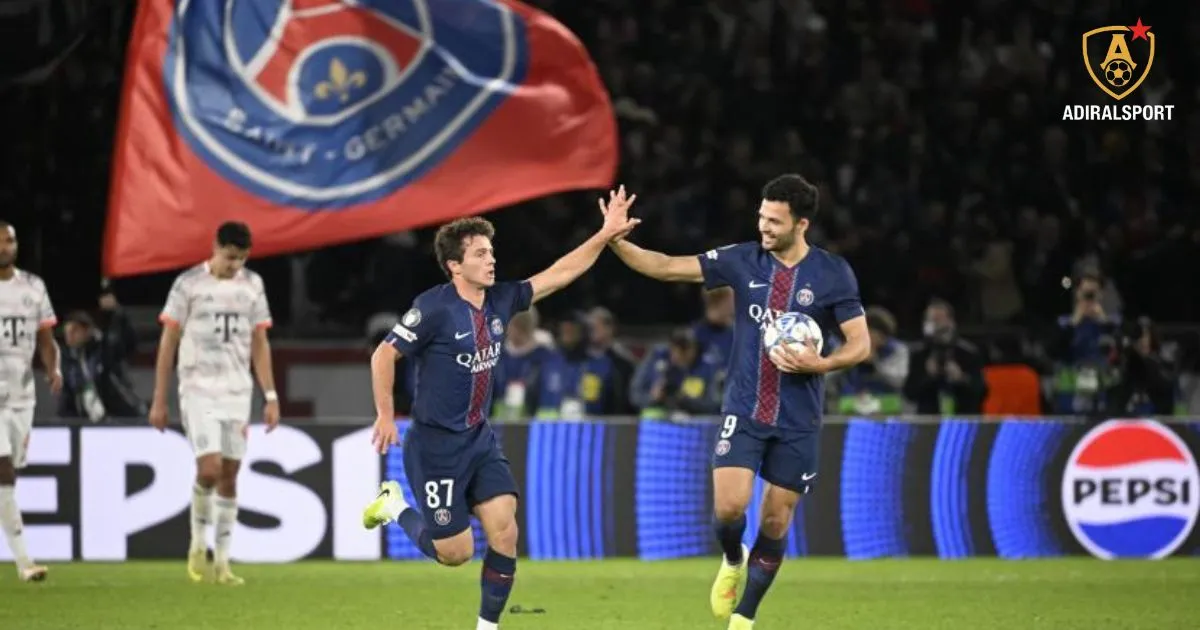
- 74′ – GOAL (PSG 1-2): Just when you thought the breakthrough would never come, it arrived in spectacular fashion. The ball was cleared to the edge of the box, where it fell to João Neves. The young Portuguese midfielder met it with a stunning, sideways volley that flew past a helpless Manuel Neuer. The goal gave PSG hope and set up a frantic, nerve-shredding final 15 minutes.
- 90’+ – Bayern Hold On: The final whistle was met with a roar from the small contingent of traveling fans. PSG threw everything forward—Marquinhos played as a makeshift striker, crosses rained in—but Bayern held on. It was a defensive masterclass, led by Upamecano and Tah, who seemed to win every header and make every block.
Kompany’s Masterclass: A PSG vs Bayern Munchen Tactical Analysis of the Bavarians
This victory was a triumph for Vincent Kompany. He proved his tactical acumen by winning the game in two completely different ways. Let’s break down the two phases of his plan.
The First Half: Proactive and Ruthless
For 45 minutes, you witnessed Bayern at their devastating best. This PSG vs Bayern Munchen tactical analysis must credit Kompany for identifying PSG’s greatest weakness: their arrogance in the build-up.
- The High Press: Bayern didn’t sit back. They pushed high, using Kane to shadow PSG’s holding midfielder (Vitinha) and the attacking trio to press PSG’s back four. They set “pressing traps,” allowing a pass to the full-back before swarming them. This directly led to the opening goal. They suffocated PSG, preventing them from ever finding their rhythm.
- Explosive Transitions: The second part of the plan was what they did after winning the ball. Upon regaining possession, Bayern bypassed the midfield. They didn’t try to out-pass PSG. They played quick, vertical, one-touch passes to Díaz, Olise, and Kane. The second goal was a perfect example. It wasn’t a long, drawn-out passing move; it was an error, an interception, and a goal. Two touches. Clinical.
- Targeting the Flanks: Kompany knew Hakimi and Mendes love to bomb forward. He used Díaz and Olise to pin them back, forcing them to think twice about leaving space in behind. This nullified a huge part of PSG’s attacking threat in the first half.
The Second Half: The 10-Man Fortress
Losing Díaz forced a complete strategic reversal. This, for many, is the real story of this PSG vs Bayern Munchen tactical analysis. Kompany’s switch to a 4-4-1 was textbook, but the execution was flawless.
- Defensive Compactness: The new shape was all about denying central space. Bayern conceded the flanks. They let PSG have the ball wide. Why? Because they trusted their two giants, Upamecano and Tah, to win every single cross. The 4-4-1 formation meant they always had a “double bank of four,” with the two lines staying incredibly close together, offering no space for PSG’s creative players to operate between the lines.
- Kimmich as the Quarterback: Joshua Kimmich’s role was immense. He was no longer just a destroyer; he was the leader. You could see him pointing, shouting, and organizing. He dropped deep, almost as a third center-back at times, breaking up play, clearing lines, and managing the game’s tempo with tactical fouls when necessary.
- Work Rate and Sacrifice: This is the unquantifiable metric. The discipline and work rate of the entire team were off the charts. Michael Olise, a flair winger, was seen making slide tackles at his own corner flag. Harry Kane, a superstar striker, spent the half chasing shadows and pressing PSG’s center-backs to disrupt their build-up, even when he was 1 vs. 3. This collective buy-in is what secured the three points. It was a defensive performance of pure grit, and a tactical masterclass in how to manage a 10-man disadvantage.
Enrique’s Frustration: A PSG vs Bayern Munchen Tactical Analysis of the Parisians
For Luis Enrique, this match will be a painful one to review. His team, tipped as favorites at home, was out-thought and out-fought. This PSG vs Bayern Munchen tactical analysis must examine where it all went wrong.
The First Half: Overwhelmed by the Press
PSG looked shell-shocked by Bayern’s intensity from the first whistle. You could see the panic every time a red shirt closed in.
- Build-up Struggles: Enrique’s entire system is built on confidently playing out from the back. Bayern, however, had done their homework. They targeted Marquinhos and Pacho, knowing they were the primary ball-players. The press was so well-coordinated that PSG’s midfielders (Vitinha, Neves) were forced to drop incredibly deep, which left a massive gap between the midfield and the attack.
- Isolated Frontline: The fluid front three, so effective on paper, was completely neutralized. Barcola, Dembélé, and Kvaratskhelia were starved of service. When they did get the ball, they were often 30-40 yards from goal, with their backs to a wall of defenders. The lack of a physical number 9 to hold up the ball and bring others into play was glaringly obvious.
The Second Half: Possession Without Penetration
This is the great paradox of the match. PSG had a man advantage and 71% of the ball… and they still looked blunt. This part of the PSG vs Bayern Munchen tactical analysis explores why you can’t just pass your way to victory.
- Lack of a Focal Point: The “fluid” frontline became a problem. With Bayern sitting so deep, there was no space to run into. What PSG needed was a target. They needed a classic striker to occupy Upamecano and Tah, to win a header, to hold the ball up and lay it off for the onrushing midfielders. Instead, the three attackers kept drifting, often getting in each other’s way.
- Slow Tempo: This was the most frustrating part for you, if you’re a PSG fan. The ball movement was often too slow, too predictable. It was a “U-shaped” passing pattern: from the right-back, to the center-back, to the left-back, and back again. There was no urgency, no risk. This slow tempo allowed Bayern’s 10 men to simply shift from side to side, comfortably watching the play in front of them.
- Over-reliance on Crosses: As frustration grew, PSG’s plan devolved. They abandoned the intricate passing and resorted to hopeful crosses. They swung in 35 crosses, but with Upamecano and Tah in dominant form, it was a losing strategy. It wasn’t until João Neves’ moment of individual, unpredictable magic that they found the net. This PSG vs Bayern Munchen tactical analysis shows that Enrique’s system lacked a “Plan B” when their “Plan A” was suffocated.
By the Numbers: The Statistics Behind the PSG vs Bayern Munchen Tactical Analysis
The stats tell the story of a lopsided game with a contradictory result. If you only looked at this table, you’d assume PSG won 3-0. The numbers are critical to this PSG vs Bayern Munchen tactical analysis.
| Metric | Paris Saint-Germain | FC Bayern Munich |
| Final Score | 1 | 2 |
| Possession | 71% | 29% |
| Expected Goals (xG) | 2.01 | 1.45 |
| Total Shots | 25 | 9 |
| Shots on Target | 9 | 5 |
| Corners | 9 | 1 |
| Fouls | 8 | 14 |
| Red Cards | 0 | 1 (Luis Díaz) |
Key Insight: The disparity between PSG’s 71% possession and their final xG of 2.01 is the central theme. It proves that possession is not everything. PSG took 25 shots, but many were low-quality chances from outside the box. This generated a decent xG, but Bayern’s 1.45 xG from just 9 shots tells you their chances were more clinical.
Bayern over-performed their xG (scoring 2 goals from 1.45 xG), while PSG massively under-performed (scoring 1 from 2.01 xG). This, combined with the 9-to-1 corner count, paints a perfect picture: PSG had all the ball and all the territory, but Bayern had the clinical edge and the defensive grit. This is the ultimate lesson from this PSG vs Bayern Munchen tactical analysis.
Conclusion: Key Takeaways from a Night of Tactical Drama / PSG vs Bayern Munchen Tactical Analysis
This PSG vs Bayern Munchen tactical analysis of the 2025/2026 Champions League classic leaves you with three clear conclusions that will define the rest of these two clubs’ seasons:
- Bayern’s Resilience Wins the Day: Vincent Kompany’s side proved they have more than just attacking flair. Their ability to switch from a high-octane press to a disciplined, 10-man defensive block was a tactical masterclass. They have the grit of a champion.
- PSG’s Possession Problem: Luis Enrique’s team has a clear challenge. You saw it with your own eyes. They must find a way to convert sterile domination into genuine, high-quality chances, especially against deep-lying defenses. Without a “Plan B,” their Champions League dreams will remain just that—dreams.
- A Rivalry Redefined: This match adds another fascinating chapter to the PSG-Bayern story. It was a game of two halves, defined by a single red card, and ultimately, by superior defensive organization. This PSG vs Bayern Munchen tactical analysis shows that strategy, and a bit of luck, trumps all.
FAQ: Your Questions on the PSG vs Bayern Munchen Tactical Analysis Answered
Q1: What was the main tactical takeaway from this PSG vs Bayern Munchen tactical analysis?
The main takeaway for you, as a viewer, is the power of tactical flexibility. Bayern Munich won because they could flawlessly execute two completely different game plans. They had the arrogance and aggression to win the game with their high press in the first half, and the humility and discipline to win it again with a 10-man low block in the second.
Q2: Why did PSG lose despite having 71% possession?
Possession doesn’t equal penetration. As this PSG vs Bayern Munchen tactical analysis detailed, PSG’s ball movement was too slow, and they lacked the creativity and a central focal point to break down Bayern’s disciplined 10-man defense. They racked up 25 shots, but most were low-percentage efforts that didn’t truly trouble Manuel Neuer.
Q3: How did the Luis Díaz red card change the match?
It changed everything. It forced Bayern to abandon their successful, aggressive game plan and defend for their lives for 45+ minutes. It also gave PSG total control of the ball, but paradoxically, this may have hurt them. It allowed Bayern to set up their “bus” with no ambiguity, and PSG simply didn’t have the tactical tools (like a target man) to break it down.
Q4: Who was the tactical Man of the Match in this PSG vs Bayern Munchen tactical analysis?
While Luis Díaz was decisive with his goals and red card, the tactical Man of the Match for you to study should be one of Bayern’s center-backs. Dayot Upamecano was a giant. He was the leader of that 10-man defense in the second half, winning countless aerial duels, making 10+ clearances, and ensuring the defensive line stayed compact. It was a near-perfect defensive performance under extreme pressure.
What are your thoughts on this tactical battle? Did you see the game differently? Drop your own PSG vs Bayern Munchen tactical analysis in the comments below!