
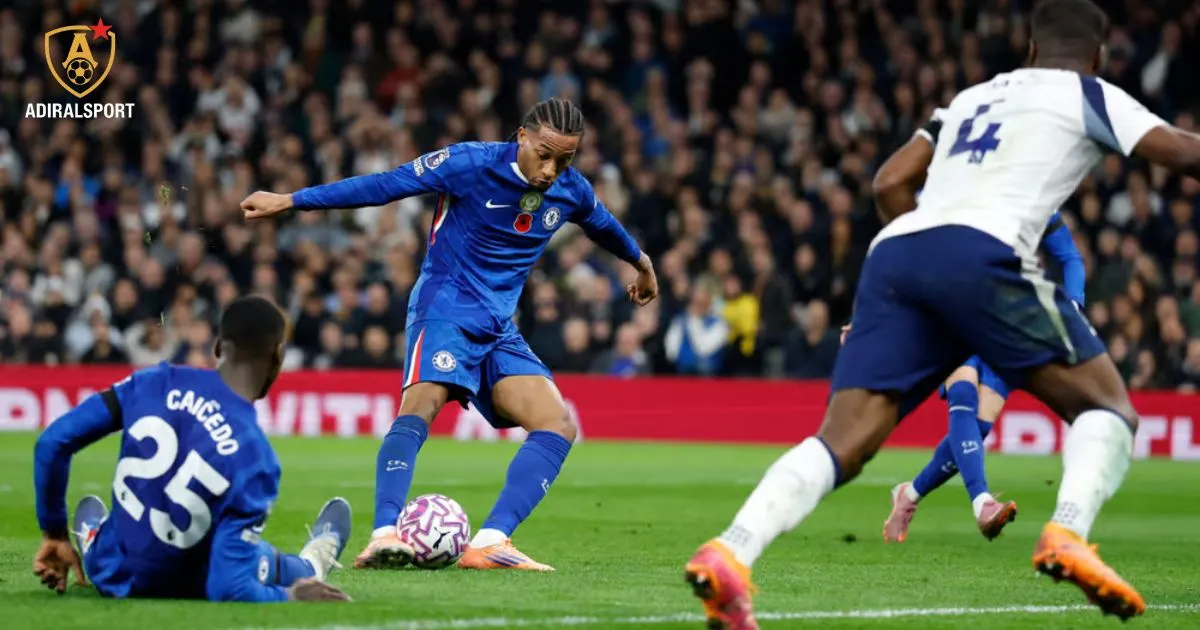
Tottenham vs Chelsea Tactical Analysis
Table of Contents
Do you ever leave a match feeling… hollow?
It’s not the fiery anger of a last-minute injustice. It’s not the frustration of a VAR call gone wrong. It’s the cold, quiet realisation that you were simply, and comprehensively, out-thought.
If you were one of the thousands walking out of the Tottenham Hotspur Stadium on this chilly November evening, you know that feeling. The 0-1 scoreline will be what’s printed in the papers, but it’s a lie. It doesn’t tell the story of the 90-minute chess match you just witnessed, where one manager brought a grandmaster’s strategy and the other… well, he brought a survival guide.
For 33 minutes, you let yourself believe. The roar of a London derby, the crackle of energy, the hope that even this injury-hit Spurs squad could find a way. Then, the system broke. A high press, a predictable turnover, a clinical finish. The air went out of the stadium.
This wasn’t just a loss; it was a lesson. You felt it from your seat. This Tottenham vs Chelsea tactical analysis is your guide through what you saw, what it means, and why it happened. We are going to dissect exactly how Enzo Maresca’s Chelsea taught a tactical lesson, minute by minute, duel by duel.
Match Summary: The Scoreline, Lineups, and Key Events
Before we dive into the deep-end analytics, you need the hard data. This Tottenham vs Chelsea tactical analysis must be built on the foundation of the facts. What you saw with your eyes is about to be backed up by the numbers.
Final Score and Starting XIs
Chelsea walked away with a 0-1 victory, but the gulf between the two sides felt far wider. The managers, Thomas Frank (Spurs) and Enzo Maresca (Chelsea), both presented a 4-2-3-1 on the team sheet, but as you quickly discovered, those formations were worlds apart in their execution.
When you first saw the lineups, what was your initial thought? For Spurs, seeing both João Palhinha and Rodrigo Bentancur told you everything you needed to know: this was about containment. Thomas Frank was battening down the hatches, hoping to smother the game.
On the other side, you saw Maresca’s sheet. Pedro Neto. Alejandro Garnacho. João Pedro. This wasn’t about containment; it was about pure, unadulterated speed and aggression.
| Tottenham Hotspur (4-2-3-1) | Chelsea (4-2-3-1) |
| Manager: Thomas Frank | Manager: Enzo Maresca |
| 1. Guglielmo Vicario (GK) | 1. Robert Sanchez (GK) |
| 23. Pedro Porro | 27. Malo Gusto |
| 4. Kevin Danso | 29. Wesley Fofana |
| 37. Micky van de Ven | 23. Trevoh Chalobah |
| 24. Djed Spence | 3. Marc Cucurella |
| 6. João Palhinha | 24. Reece James (c) |
| 30. Rodrigo Bentancur | 25. Moisés Caicedo |
| 20. Mohammed Kudus | 7. Pedro Neto |
| 29. Pape Matar Sarr | 8. Enzo Fernández |
| 15. Lucas Bergvall | 49. Alejandro Garnacho |
| 39. Randal Kolo Muani | 20. João Pedro |
Full Match Timeline: How the 90 Minutes Unfolded
The raw timeline shows a game of frantic moments for Spurs and controlled pressure from Chelsea.
- 7′ (SUB Spurs): You barely had time to finish your first “Come on you Spurs!” chant. An early, unfortunate blow. Lucas Bergvall goes down with what looks like a hamstring tweak. As you watch Xavi Simons hastily warm up and come on, you can’t help but feel the entire game plan is already being ripped up. This event forced an immediate, unplanned rethink of this Tottenham vs Chelsea tactical analysis.
- 34′ (GOAL Chelsea): This was the moment. You saw it coming. The pressure had been building. Moisés Caicedo, a blur of blue, presses high like a man possessed. He doesn’t just tackle Palhinha; he mugs him. The ball is loose, but it’s part of the plan. It’s fed instantly to João Pedro, who makes no mistake. A cool, clinical finish. 0-1. You could hear a pin drop in the home sections.
- 45+4′ (YELLOW): Rodrigo Bentancur (Spurs) booked. A tackle born of pure frustration.
- 45+4′ (YELLOW): Trevoh Chalobah (Chelsea) booked. A cynical, but smart, foul to stop a rare Spurs break.
- 47′ (YELLOW): Kevin Danso (Spurs) booked. He’s left one-on-one with Garnacho and has no choice but to haul him down.
- 59′ (SUB Spurs): You can feel Frank’s desperation. A double change. Cristian Romero and Richarlison replace Kevin Danso and Rodrigo Bentancur. It’s a switch to a back three, a “Hail Mary” to find some grip on the game.
- 59′ (YELLOW): Xavi Simons (Spurs) booked. The substitute, trying to make an impact, flies in late.
- 66′ (SUB Chelsea): Jamie Bynoe-Gittens replaces Alejandro Garnacho. Maresca swaps one speedster for another, keeping the pressure on.
- 68′ (YELLOW): Enzo Fernández (Chelsea) booked.
- 73′ (SUB Spurs): The kitchen sink. A triple change. Wilson Odobert, Destiny Udogie, and Brennan Johnson replace Pedro Porro, Randal Kolo Muani, and, tellingly, the substitute Xavi Simons. Frank has no idea what to do.
- 74′ (YELLOW): Mohammed Kudus (Spurs) booked. More frustration.
- 76′ (SUB Chelsea): Roméo Lavia replaces Malo Gusto. Maresca senses the frantic energy and adds another body to his midfield to kill the game.
- 85′ (SUB Chelsea): Estevão Willian replaces Pedro Neto.
- 89′ (SUB Chelsea): Tosin Adarabioyo replaces Wesley Fofana to see out the game.
- 90+3′ (CHANCE): Your heart is in your mouth. A rare Chelsea mistake, Bynoe-Gittens is clean through… and he skies it. A huge let-off.
- 90+4′ (SAVE): Guglielmo Vicario makes a stunning, point-blank save on João Pedro. The whistle blows moments later. You feel… relief? It was only 0-1.
The Numbers Don’t Lie: A Statistical Deep Dive and Tottenham vs Chelsea Tactical Analysis
The timeline tells you what happened. The stats tell you why. If you felt like Spurs were pinned back, defending for their lives, and creating absolutely nothing, your eyes were not deceiving you.
This Tottenham vs Chelsea tactical analysis is where the story of the game is written in cold, hard numbers. Look at this table. Really look at it.
Full-Time Match Statistics (Tottenham 0-1 Chelsea)
| Metric | Tottenham Hotspur | Chelsea |
| Possession % | 44% | 56% |
| Total Shots | 3 | 19 |
| Shots on Target | 1 | 9 |
| Goalkeeper Saves | 8 | 1 |
| Total Passes | 384 | 482 |
| Pass Accuracy | 77% | 85% |
| Corners | 6 | 5 |
| Fouls Committed | 14 | 10 |
| Yellow Cards | 4 | 2 |
| Red Cards | 0 | 0 |
| Expected Goals (xG) | 0.21 | 2.58 |
What Do These Numbers Really Mean?
You don’t need to be a data scientist to understand this.
- xG (Expected Goals): 0.21 vs 2.58. This is the most damning stat of all. It means from the chances Spurs created, you would expect them to score a goal about once every five games. It was, statistically, nothing. In contrast, Chelsea’s 2.58 xG tells you they created enough high-quality chances to have scored two or three goals. You weren’t watching a tight 0-1; you were watching a 0-3 game that Vicario saved.
- Shots: 3 vs 19. Think about that. Three shots in 90 minutes. At home. In a derby. One of those was on target. Chelsea, meanwhile, were peppering Vicario, forcing him into 8 saves. You felt the barrage from the stands.
- Pass Accuracy: 77% vs 85%. This gap is a canyon. 77% is the number of a team that is panicked, rushed, and hoofing the ball long. 85% is the number of a team that is calm, collected, and executing a plan.
- Possession: 44% vs 56%. This isn’t just about having the ball; it’s about what you do with it. Chelsea’s possession was “proactive,” used to build attacks. Spurs’ possession was “reactive,” often won deep in their own half with no way out.
This Tottenham vs Chelsea tactical analysis of the stats shows one thing clearly: This was dominance versus desperation.
The Managerial Chess Match: A Head-to-Head Tottenham vs Chelsea Tactical Analysis
This is the core of it all. This is the 4D chess game you were watching unfold. The game was won and lost on the touchline. What you witnessed was a clash of philosophies: Enzo Maresca’s rigid, complex system against Thomas Frank’s injury-forced, pragmatic survivalism.
This is the central, most important part of our Tottenham vs Chelsea tactical analysis.
Frank’s Frustration: A Tottenham vs Chelsea Tactical Analysis of Spurs’ Rudimentary Plan
Let’s put you in Thomas Frank’s shoes for a moment. You’re heading into a London derby without your two chief creators, James Maddison and Dejan Kulusevski. Your options are limited. What’s your move?
You saw his answer: Contain and Counter.
- Defensive Setup: Frank’s 4-2-3-1 was a mirage. In reality, it was a deep, compact 4-4-2 block. You saw Palhinha and Bentancur sitting so deep they were almost stepping on the centre-backs’ toes. Kudus and the sub Simons were asked to be wingers, but they spent the entire game as auxiliary full-backs. The plan was to create a “box midfield” to deny Enzo Fernández and Caicedo any space in the middle.
- The “Attacking” Plan: This is where it all fell apart. The plan in possession wasn’t a plan at all; it was a prayer. You must have been screaming at the TV, “Stop kicking it long!” But that was the tactic.
- The Long Ball Fallacy: The order was clear: bypass the midfield (which Chelsea was dominating anyway) and hit hopeful, 60-yard punts towards Randal Kolo Muani.
- Why it Failed: You watched Robert Sanchez come out and claim these high balls as if he were catching feathers. Kolo Muani is a striker who thrives on runs in behind, not on battling two giant centre-backs (Fofana and Chalobah) in the air. He was isolated, frustrated, and totally ineffective.
- Lack of Width: With no natural wingers and Djed Spence (not a natural LWB) playing on the left, Spurs had no out-ball. Every “attack” was funnelled into the congested, Chelsea-controlled centre.
- The Verdict: This Tottenham vs Chelsea tactical analysis has to be blunt. You were watching a team that was abject, limp, and tactically rudderless. The five substitutions Frank made in the second half weren’t tactical tweaks; they were desperate throws of the dice, changing personnel without changing the broken system.
Maresca’s Masterclass: A Tottenham vs Chelsea Tactical Analysis of Chelsea’s Coordinated Attack
Now, let’s look at the other dugout. If you’ve followed Enzo Maresca’s career (from Man City’s EDS to Leicester), you know his philosophy is non-negotiable. It’s a positional play system that demands bravery, intelligence, and relentless pressing.
And you just watched it work to perfection.
- The High Press: This was Chelsea’s main weapon, and it’s the signature of Maresca’s football. His press isn’t just about “running hard.” It’s about triggers. You saw it time and time again.
- The Trigger: The moment a Spurs defender (like Danso or Van de Ven) played the ball into the pivot (Palhinha), that was the signal.
- The Trap: Instantly, João Pedro would cut off the pass back to the keeper, Enzo Fernández would push up on the other pivot, and Caicedo would fly in to attack the man on the ball. Palhinha had no options. He was trapped. This is exactly what forced the long balls that Frank’s plan relied on. Maresca’s press created Frank’s failed tactic.
- The Goal: A Systemic Masterpiece: Let’s replay that 34th minute in our minds, as it’s the defining moment of this Tottenham vs Chelsea tactical analysis.
- Vicario plays it short to Palhinha.
- This is the trigger. Caicedo is already on his horse, anticipating the pass.
- Palhinha takes a slightly heavy touch, but it doesn’t matter. He’s surrounded. Caicedo, backed by James and Enzo, presses high.
- Caicedo wins the 50/50. But he doesn’t just win it. He wins it forwards.
- He immediately finds João Pedro, who has intelligently held his position in the pocket of space.
- One touch to control, one touch to finish. Goal.You just witnessed a goal that wasn’t a moment of individual brilliance, but the end product of a perfectly drilled, systemic machine.
- Midfield Dominance (The ‘Inverted’ Captain): Did you notice where Reece James was playing? He wasn’t bombing down the right wing. When Chelsea had the ball, James moved inside to play as a second central midfielder alongside Caicedo.
- This is a classic “inverted full-back” move, straight from the Guardiola/Maresca playbook.
- What did this do? It created a 3-v-2 (James, Caicedo, Enzo) or even 4-v-2 (with Pedro dropping) overload in the centre of the park. You were watching Sarr and Bentancur get completely outnumbered and run ragged, chasing shadows. This is why Chelsea’s 85% pass accuracy was so easy to achieve. They always had a free man.
This Tottenham vs Chelsea tactical analysis shows a clear winner in the managerial department. Maresca had a plan to create chances; Frank had a plan to stop them. In modern football, you know which one wins.
Where the Game Was Decided: A Micro-Level Tottenham vs Chelsea Tactical Analysis
Beyond the grand strategies, football matches are decided by individual duels. When you boil it all down, these three micro-battles tell the full story. This Tottenham vs Chelsea tactical analysis pinpoints the precise areas where the match was lost and won.
The Key Duel: The Caicedo Engine vs. The Spurs Void
- Winner: Moisés Caicedo
- Analysis: You simply could not take your eyes off him, could you? This Tottenham vs Chelsea tactical analysis could just be a 90-minute highlight reel of his performance. He wasn’t just in the midfield; he was the midfield.
- You watched him as a destroyer, making 5 tackles and 3 interceptions. He was the engine of the press, the man who set the trap.
- You watched him as a creator. His assist for the goal was the perfect example of transitioning from defence to attack in one movement.
- Against him, Spurs offered a void. Palhinha was overwhelmed, and Bentancur was chasing ghosts. Caicedo played a game that showed you exactly why Chelsea paid over £100m for him. He was a one-man tactical system.
The Isolation: Randal Kolo Muani vs. Chalobah & Fofana
- Winner: Chelsea’s Centre-Backs
- Analysis: Did you feel for Kolo Muani? You must have. You sign one of Europe’s most dynamic forwards, a man who thrives on clever movement and through balls, and you ask him to play as a 1990s target man.
- This Tottenham vs Chelsea tactical analysis of his game is a sad one. He was starved of service.
- Every “pass” to him was a 60-yard punt from Vicario or Van de Ven.
- You saw him jump, again and again, against the towering and physical duo of Wesley Fofana and Trevoh Chalobah. He had no chance. He won maybe one or two aerial duels all night.
- This wasn’t Kolo Muani’s failure; it was a tactical failure. He was a world-class tool used for the wrong job, like asking a surgeon to chop wood. His substitution on 73 minutes was a mercy.
The Resistance: Guglielmo Vicario vs. Chelsea’s System
- Winner: Vicario (personally), but Chelsea (tactically)
- Analysis: Let’s be brutally honest. You were bracing for 0-3, 0-4. You felt it. The only reason this Tottenham vs Chelsea tactical analysis isn’t about a total rout is the man in goal for Spurs.
- Guglielmo Vicario made 8 saves. Eight.
- You’ll remember the point-blank stop on João Pedro in the 94th minute.
- You’ll remember the fingertip save from Bynoe-Gittens’ curler in the 93rd.
- You’ll remember him scrambling to tip an Enzo Fernández shot over the bar in the first half.
- His performance was heroic, but it also highlights the core problem. Your goalkeeper should not have to be the Man of the Match at home just to keep the score at 0-1. Vicario’s brilliance papered over the enormous tactical cracks.
Final Verdict: What This Tottenham vs Chelsea Tactical Analysis Tells Us
So, what’s the final word? What do you take away from this chilly night in North London?
This wasn’t a “smash and grab.” This wasn’t a lucky deflection. This was, as you’ve seen, a complete and total tactical dismantling.
This Tottenham vs Chelsea tactical analysis confirms two things you probably already suspected. First, Enzo Maresca’s high-press, possession-based system is not just “nice to watch”—it’s ruthlessly effective. It’s clicking. Chelsea’s only criticism? Their wastefulness. You saw them create enough chances to end this contest by the 60th minute. They must be more clinical.
Second, for Spurs, this is a blaring alarm bell. You can blame injuries, and they are a massive factor. But even with a weakened squad, you must have an identity. You must have a plan to attack. This Tottenham vs Chelsea tactical analysis for the 2025/2026 season shows a Spurs side under Thomas Frank that, when Plan A (Maddison) is gone, has no Plan B. Pragmatism is fine, but this was tactical surrender.
You witnessed one team on a clear upward trajectory, and another in desperate need of a long look in the mirror.
Your Tottenham vs Chelsea Tactical Analysis 2025/2026 FAQ
You’ve got questions. We’ve got answers based on what we all just watched.
What was the main takeaway from this Tottenham vs Chelsea Tactical Analysis?
The biggest thing you should take away is that a clear, proactive system beats reactive, fearful tactics every single time. You saw Chelsea’s coordinated high press, built around an inverted full-back and a dominant midfield, completely suffocate a Spurs side that had no answer other than a hopeful (and failed) long ball.
Who was the Man of the Match based on this tactical analysis?
It’s tempting to give it to João Pedro for the goal, or Guglielmo Vicario for his 8 saves. But if you re-watch the match, you’ll see it was Moisés Caicedo. This Tottenham vs Chelsea tactical analysis highlights him as the engine. He was the destroyer who won the ball, and the creator who set up the goal. A colossal performance.
How did the injuries impact the Tottenham vs Chelsea Tactical Analysis?
You can’t ignore them. Losing your two main creators, Maddison and Kulusevski, would cripple any team’s attacking plans. It directly forced Thomas Frank’s hand, making him opt for a defensive, low-block shell. But the real question this Tottenham vs Chelsea tactical analysis poses is this: Did it force him to play that badly? Did it remove any possibility of a short passing game or a coherent counter-attack? Probably not.
Why did Chelsea dominate possession in this Tottenham vs Chelsea Tactical Analysis?
You saw it happen for two main reasons. First, Chelsea’s technical quality and tactical setup (that 3-v-2 overload in midfield) meant they could pass around Spurs’ press with an 85% accuracy. Second, you had Spurs intentionally giving the ball away. Every long ball from Vicario or the centre-backs was a turnover. You simply cannot hold possession when your primary tactic is to kick it 60 yards up the pitch.
What Did You See?
This is our Tottenham vs Chelsea tactical analysis, but football is a game of a million opinions. What did you see from your seat or on your screen? Did you agree with Frank’s defensive setup? Was Caicedo your Man of the Match, or did Vicario’s heroics earn it?
Drop your own Tottenham vs Chelsea tactical analysis in the comments below, and let’s debate the beautiful game.