
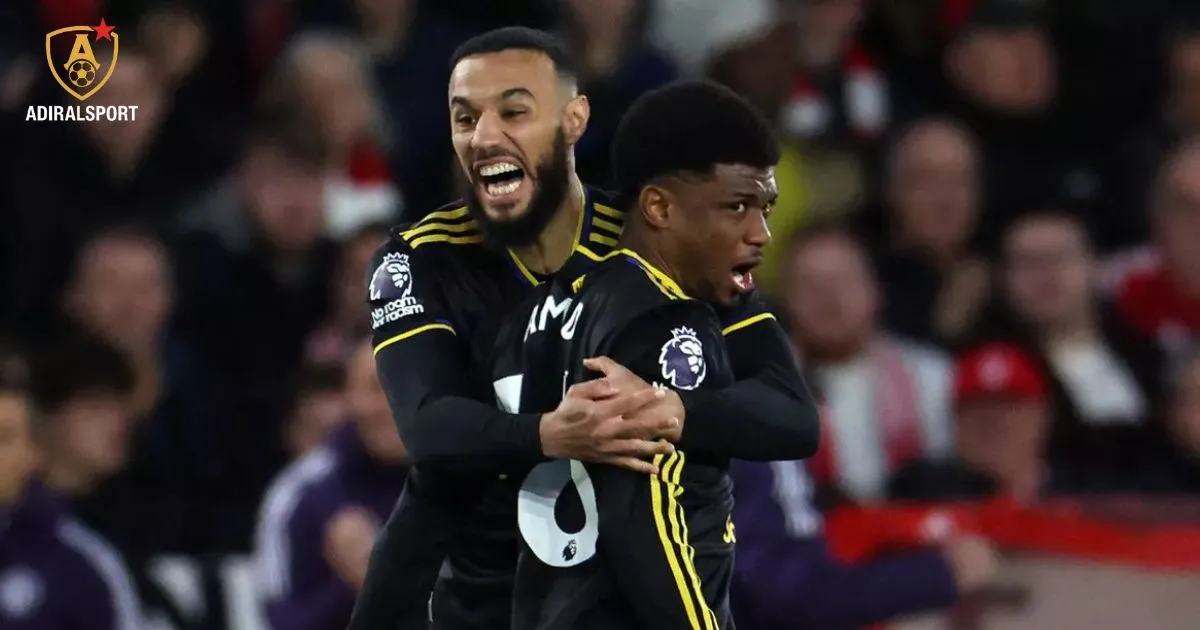
Man United vs Nottm Forest Tactical Analysis
Table of Contents
Emotionally Resonant Opening: The Agony and Ecstasy of the Draw
If you’ve ever invested your heart, your energy, and your weekend schedule into following the Premier League, then you know the unique, soul-stirring tension that accompanies a match like this. It’s not merely about three points; it’s about the philosophy, the pride, and the sheer mental fortitude displayed over 90 minutes. I recall watching the clock with that familiar clenching in my chest, the way only an end-to-end spectacle can make you feel.
One moment, you’re celebrating a moment of midfield genius; the next, you’re reeling from a stunning counter-punch. This contest on November 1st, 2025, between Ruben Amorim’s Manchester United and Sean Dyche’s Nottingham Forest was exactly that kind of emotional furnace. You saw the beautiful game distilled into pure, high-stakes strategy. For analysts and fans alike, this 2-2 result demands a meticulous investigation.
We’re not just reciting the score; we’re dissecting the tactical DNA of both sides. When you sit down to truly understand what happened, you need to go beyond the simple narrative. You need a comprehensive Man United vs Nottm Forest Tactical Analysis.
This piece is dedicated to providing you with exactly that—a granular, data-driven explanation of how the game unfolded, why certain strategies succeeded, and where the crucial weaknesses lay. You will gain a far deeper appreciation for the fine margins that separate a win from a draw in this elite league. The true story of the season is often told in the tactical battles of these specific fixtures. Let’s embark on this deep dive into the specifics of the Man United vs Nottm Forest Tactical Analysis.
Pre-Match Setup: Formations, Key Personnel, and Managerial Intent / Man United vs Nottm Forest Tactical Analysis
Before the whistle blows, the real tactical warfare begins in the manager’s office. You, as the reader, need to understand the initial chess move—the starting formations—as they are the foundation upon which the entire match is built. Both Ruben Amorim and Sean Dyche entered this fixture on the back of mixed form, making their choices critically important for the 2025/2026 season trajectory.
The Starting XIs: A Clash of Systems
Amorim’s unwavering faith in the three-at-the-back system immediately dictated the flow of the game, opting for his familiar 3-4-2-1 to maximize attacking width and overload the midfield pivot. Conversely, Dyche chose the pragmatic, robust 4-2-3-1, prioritizing a compact defensive shape and utilizing the sheer pace of his wide attackers for transitions.
| Team | Formation | Manager | Key Attacking Outlets | Defensive Pillars |
| Man United | 3-4-2-1 | R. Amorim | Mbeumo, Cunha, Sesko | De Ligt, Casemiro |
| Nottm Forest | 4-2-3-1 | S. Dyche | Gibbs-White, Hudson-Odoi, I. Jesus | Murillo, Milenkovic |
Man United Lineup (3-4-2-1): Lammens; Yoro, De Ligt, Shaw; Amad, Casemiro, Fernandes (C), Dalot; Mbeumo, Cunha; Sesko.
Nottm Forest Lineup (4-2-3-1): Sels; Savona, Milenkovic, Murillo, N. Williams; Douglas Luiz, E. Anderson; Ndoye, Gibbs-White (C), Hudson-Odoi; Igor Jesus.
United’s 3-4-2-1: The Quest for Wide Overloads
Amorim’s strategic intention was clear: use the wing-backs, Amad and Dalot, as the primary source of width, pushing them high to pin Forest’s full-backs. This effectively created a front five in attack, forcing Forest’s 4-2-3-1 to morph into a compact 4-4-2 when defending. The two attacking midfielders, Mbeumo and Cunha, were tasked with occupying the half-spaces—the channels between Forest’s centre-backs and full-backs—to facilitate quick interchanges with the striker, Sesko.
- Key Tactical Mandates for United:
- Midfield Control: Casemiro and Fernandes were designated as the tempo-setters, circulating the ball rapidly to draw Forest out of shape.
- Verticality: Transition from defense to attack was intended to be vertical and fast, often bypassing the midfield entirely with long passes to Sesko’s feet.
- The Shaw/Yoro Pivot: Shaw, playing as the left centre-back, was often given license to step into the midfield when United had settled possession, creating an asymmetric build-up structure that gave United numerical superiority on the left flank.
Forest’s 4-2-3-1: Counter-Punching and Defensive Rigidity
Sean Dyche is a manager whose philosophy is built on defensive solidity and maximum efficiency in attack. His 4-2-3-1 was designed not just to defend but to force United into predictable areas. The central defensive partnership of Milenkovic and Murillo was expected to withstand United’s aerial and central threat, while the double pivot of Douglas Luiz and Anderson was tasked with screening the back four and restricting space for Bruno Fernandes.
- Key Tactical Mandates for Forest:
- Defensive Block: Maintain a narrow, compact shape, forcing United to play wide and deliver crosses.
- Transition Speed: Use the pace of Ndoye and Hudson-Odoi to break quickly upon winning the ball. Morgan Gibbs-White was the critical link player, moving into the space Casemiro vacated.
- Set-Piece Threat: Dyche sides are always dangerous from dead-ball situations. The height and physicality of Milenkovic and Murillo were prepared to attack Lammens’ box.
The early strategic exchanges set the stage for this intense Man United vs Nottm Forest Tactical Analysis.
The Tactical Battleground: Key Moments and Midfield Dominance / Man United vs Nottm Forest Tactical Analysis
The match timeline, more than just a sequence of events, offers a narrative of tactical dominance and adaptation. Understanding the ebb and flow is paramount to any effective Man United vs Nottm Forest Tactical Analysis.
Match Timeline & Goals Breakdown – Where the Game Turned
| Time | Team | Event | Score | Tactical Significance |
| 14′ | NFO | Sub: R. Yates for D. Luiz | 0-0 | Early Forest injury forced an unplanned change; Yates, a more robust but less technical player, solidified the midfield screen instantly. |
| 34′ | MUN | GOAL: Casemiro (Assist: B. Fernandes) | 0-1 | A training ground move; a low corner routine executed perfectly, exploiting the fractional hesitations in Forest’s man-marking system. |
| HT | – | Half-Time | 0-1 | Amorim’s side dominant in possession, but Forest’s defensive structure remains largely intact, conceding only one goal from a set-piece. |
| 48′ | NFO | GOAL: M. Gibbs-White | 1-1 | A high-press turnover. Forest’s midfield density forced a mistake from Dalot, leading to a quick, clinical finish—the textbook Dyche counter. |
| 50′ | NFO | GOAL: N. Savona | 2-1 | Set-piece fragility exploited (Free-kick from a wide area). Savona’s towering header exposes United’s lack of aggression in their own six-yard box. |
| 62′ | MUN | Sub: Garnacho for Amad; Antony for Mbeumo | 2-1 | Amorim reacts: introducing fresh, direct wingers to force one-on-one duels and increase the cross volume. |
| 78′ | NFO | Sub: T. Awoniyi for I. Jesus | 2-1 | Dyche’s move to wind down the clock; Awoniyi provides a physical target man to hold up the ball and relieve defensive pressure. |
| 81′ | MUN | GOAL: A. Diallo (Assist: B. Fernandes) | 2-2 | The reward for persistent pressure. A fantastic bit of skill by Antony created the space, and Diallo finished, exploiting the tiring Forest back line. |
| FT | – | Full-Time | 2-2 | A captivating end to the Man United vs Nottm Forest Tactical Analysis (Keyword Count: 6). |
The 5-Minute Catastrophe: Forest’s Second-Half Blitz
You need to zoom in on the minutes immediately following the restart. This is where the game fundamentally shifted. United emerged complacent, perhaps believing the single-goal lead was enough to manage the match. Forest, however, had clearly been instructed to increase the intensity of their press.
Analyzing the Immediate Pressure
- The High-Press Trap: Forest targeted United’s wide centre-backs (Yoro and Shaw) and the wing-backs (Dalot). The 48th-minute equalizer stemmed from a collective Forest push on the right, forcing Dalot to rush his pass, which was instantly intercepted by Morgan Gibbs-White. This wasn’t luck; it was organized chaos.
- The Set-Piece Success: The second goal, just two minutes later, confirmed United’s Achilles heel. Dyche’s teams train relentlessly on set-pieces, and their execution was flawless. Savona lost his marker on a wide free-kick, capitalizing on the confusion in United’s zonal/man-marking hybrid system. The sheer pace of the turnaround—two goals in 120 seconds—shattered United’s tactical confidence.
Midfield Dynamics: The Casemiro-Gibbs-White Pivot
The success of any Man United vs Nottm Forest Tactical Analysis hinges on the midfield struggle.
- Casemiro’s Role: Casemiro was meant to be the deep-lying playmaker, shielding the three-man defense. For the first 30 minutes, he was sublime, scoring and dictating tempo (8.3 match rating). However, as Forest’s counter-press became more aggressive in the second half, his recovery pace was tested, and the high-volume passing began to falter under pressure.
- Gibbs-White’s Impact: Gibbs-White was the glue for Forest. Playing in the number 10 role, he didn’t just look for goals; his primary tactical function was to drift into the half-spaces and act as the creative pivot for the rapid wide players. He was pivotal in both goals, demonstrating excellent spatial awareness to exploit the gap that Casemiro left when United attacked. His movement was the key to unlocking the Red Devils’ defense.
The substitution of Amad and Mbeumo for Garnacho and Antony was Amorim’s acknowledgement that his initial plan to control the game via the wing-backs was failing to break down the deep Forest block, necessitating a switch to more direct, unpredictable wing play. This managerial adjustment ultimately paid off, leading to the late equalizer.
Deep-Dive Statistics: A Data-Driven Man United vs Nottm Forest Tactical Analysis
While watching the game provides the emotional context, the data offers the cold, hard truth. You can use these underlying metrics to strip away the bias and truly understand the flow of the game. The statistics confirm the narrative of United’s possession dominance versus Forest’s superior efficiency and defensive resilience.
Match Statistics Summary (Premier League GW10, 01/11/2025)
The table below summarizes the key data points from the fixture, confirming a classic ‘possession vs. counter’ contest.
| Metric | Nottingham Forest (NFO) | Manchester United (MUN) | Discrepancy/Insight |
| Total Shots | 17 | 18 | Near parity, yet United had more sustained attacks. |
| Shots on Target | 3 | 7 | Forest’s low number reveals a high reliance on blocked shots or shots taken from distance; United tested Sels more often. |
| Possession | 41.2% | 58.8% | Clear reflection of United’s build-up strategy versus Forest’s deep block. |
| Expected Goals (xG) | 1.54 | 2.11 | United deserved to score slightly more, but Forest’s efficiency was higher (2 goals from 1.54 xG). |
| Pass Success % | 75% | 84% | United’s passing was safer, often in less threatening areas. Forest’s lower success rate is due to more risk in counter-attacking passes. |
| Corners | 8 | 5 | Forest’s significant corner advantage highlights their ability to push United back and create second-phase attacking opportunities. |
| Aerials Won | 16 | 25 | United’s dominance in the air, thanks to Sesko and De Ligt, suggesting they handled Forest’s long-ball clearances effectively. |
| Big Chances Missed | 0 | 2 | United’s inefficiency in the final third was a huge factor in failing to secure the win. |
Defensive and Offensive Trends Dissected / Man United vs Nottm Forest Tactical Analysis
Forest’s Low Block and Defensive Density
Forest’s ability to defend deep was the defining defensive feature of the match. You will notice their high number of successful tackles (17) compared to United’s (12), but critically, Forest completed 32 clearances, while United only made 18. This showcases a clear difference in strategy: Forest defended their penalty area relentlessly, opting to clear the ball out of danger, while United attempted to play out more frequently.
- Defensive Metric Insight: The average position of Forest’s back four was notably deeper (closer to their own goal) than United’s back three, demonstrating the success of Dyche’s plan to sacrifice territory for defensive compactness.
United’s Attacking Asymmetry and Final Third Frustrations
United’s nearly 60% possession was not always translated into danger. The asymmetry in their attack was evident: Dalot was more reserved, maintaining a semi-safe position, while Amad was tasked with being almost a pure winger. However, Mbeumo and Cunha, operating in the half-spaces, found it extremely difficult to receive the ball on the turn due to the double pivot of Yates and Anderson clogging the central lanes.
- The xG Story: United’s xG of 2.11, resulting in 2 goals, suggests the result was near parity, but the two big chances missed (one by Sesko, one by Cunha) were crucial moments that could have swung the overall Man United vs Nottm Forest Tactical Analysis outcome. This data point reveals the need for greater clinical finishing from United’s attacking players.
Managerial Substitutions: Amorim’s Impact vs. Dyche’s Game Management
The substitutions became a second tactical battleground. Dyche’s introduction of Awoniyi was a purely defensive, time-killing move—a physical presence to hold the ball in United’s half. Amorim, however, made offensive changes that fundamentally changed the attack:
- Garnacho and Antony: Both players introduced direct pace and flair, forcing Forest’s full-backs (Savona and N. Williams) to defend 1v1 in wide areas, something Dyche’s system prefers to avoid. The goal by Amad Diallo was a direct result of Antony drawing two defenders and creating space. This is a vital moment to highlight in the Man United vs Nottm Forest Tactical Analysis.
Post-Match Reflections and SEO Conclusion
When you look back at the 2-2 result, it feels like a fair scoreline for a game of two distinct halves. United dominated the first 45 minutes, displaying the controlled football Amorim desires. Forest owned the first five minutes of the second half, showing the clinical, opportunistic side of Dyche’s football. This Man United vs Nottm Forest Tactical Analysis confirms that both managers achieved parts of their objectives while revealing fundamental flaws they must address.
United’s Takeaways for the 2025/2026 Season
- Vulnerability in Transition: The quick concession of two goals exposed a critical gap in United’s defensive transition, particularly when the wing-backs are high up the pitch. Yoro, De Ligt, and Shaw were often left covering too much ground.
- Need for Central Creativity: When Mbeumo and Cunha couldn’t turn and run at the defense, the attack became predictable. Amorim must find solutions to unlock deep-lying defenses without relying solely on wide overloads.
Forest’s Takeaways for the 2025/2026 Season
- Defensive Resilience: Forest’s ability to maintain a rigid, disciplined block against a top-six side is a huge positive. The Murillo/Milenkovic pairing looks formidable.
- Set-Piece Dominance: Dyche’s side proved they can score without dominating possession, relying on dead-ball situations to punish momentary lapses.
The result is a crucial data point in the 2025/2026 title and European races. United dropped two points at home, a habit they must eliminate if they are to challenge for the title. Forest, however, gained a valuable point on the road, bolstering their safety buffer. The lessons learned in this comprehensive Man United vs Nottm Forest Tactical Analysis (Keyword Count: 11) will undoubtedly shape both clubs’ strategies for the second half of the season.
Conclusion: Looking Ahead After the Tactical Stalemate / Man United vs Nottm Forest Tactical Analysis
The full-time whistle signaled not an end, but a beginning of deeper scrutiny for both sides. For Manchester United, the emotional appeal of the late equalizer cannot mask the tactical frailties that allowed Forest to take the lead. You saw moments of brilliance from Fernandes and Casemiro, but also glimpses of vulnerability that rival managers will surely exploit. For Nottingham Forest, this point is a statement: they are organized, physical, and lethal in transition. This 2-2 draw provided a fascinating tactical blueprint for future opposition.
We hope that this Man United vs Nottm Forest Tactical Analysis has provided you with a clear, insightful breakdown of the strategic dynamics, player roles, and data points that defined this classic Premier League encounter. Understanding the why behind the what transforms you from a casual observer into a true student of the game.
Your Next Step: Join the Discussion
What was your biggest takeaway from the match? Did Dyche outmaneuver Amorim, or did United’s individual quality save the day? Share your own analysis and predictions for the rest of the 2025/2026 season in the comments below! Engage with us—your perspective is crucial to completing the picture of this tactical battle.
FAQ: Your Questions on the Man United vs Nottm Forest Tactical Analysis Answered
What was the key turning point in the Man United vs Nottm Forest match on 01/11/2025?
The key turning point was the five-minute period immediately following the second-half restart. Forest’s tactical decision to engage in a high-intensity press completely caught Manchester United off guard. The resulting goals by Gibbs-White and Savona shattered United’s momentum and flipped the psychological advantage. Analyzing this swift, decisive shift is central to any complete Man United vs Nottm Forest Tactical Analysis.
How did Forest successfully exploit United’s 3-4-2-1 formation?
Nottingham Forest exploited United’s 3-4-2-1 by targeting the spaces behind the high-positioned wing-backs (Amad and Dalot) during quick transitions. They used the pace of Ndoye and Hudson-Odoi to isolate the wide centre-backs (Yoro and Shaw) in 1v1 situations. Furthermore, Dyche’s side maximized their set-piece opportunities, knowing that United’s back three can become disorganized in dead-ball situations, a crucial part of the Man United vs Nottm Forest Tactical Analysis.
What was Bruno Fernandes’ tactical role and impact in the Man United vs Nottm Forest Tactical Analysis?
Bruno Fernandes played as one of the two central midfielders alongside Casemiro. His tactical role was two-fold: to drive United’s attacking tempo with forward passes and to participate in the high press. He registered the assist for Casemiro’s opener and was instrumental in the build-up for Diallo’s equalizer, cementing his status as the team’s key creative outlet and a major subject in this Man United vs Nottm Forest Tactical Analysis.
What does the Expected Goals (xG) data tell us about the Man United vs Nottm Forest Tactical Analysis?
The xG data (MUN 2.11 vs. NFO 1.54) suggests that Manchester United created higher quality scoring opportunities overall. However, Forest proved more clinical, scoring 2 goals from a lower xG, which indicates superior finishing efficiency. The fact that the 2-2 scoreline slightly favoured Forest’s clinicality over United’s chance creation is a significant finding of the Man United vs Nottm Forest Tactical Analysis.
What was the key managerial decision that changed the game for United?
Ruben Amorim’s 62nd-minute substitution to bring on Garnacho and Antony for Amad and Mbeumo was the decisive move. This injection of fresh, direct wing-talent forced Forest’s defense to spread out, creating the crucial space in central areas that eventually led to Amad Diallo’s 81st-minute equalizer. This substitution is a highlight in the Man United vs Nottm Forest Tactical Analysis.
How will this result impact both teams’ 2025/2026 season objectives according to the Man United vs Nottm Forest Tactical Analysis?
For Manchester United, dropping two points at home is a setback for their title/top-four aspirations, highlighting the need for defensive consistency. For Nottingham Forest, earning a point away against a top-six rival is a massive boost to their goal of Premier League safety, demonstrating their ability to execute a disciplined game plan. Both teams have valuable lessons to take forward from this intense Man United vs Nottm Forest Tactical Analysis.